




Materials science startup A&B Smart Materials recently successfully closed its £1.5m pre-seed round which saw significant investor interest and was heavily oversubscribed.
The company is developing sustainable superabsorbent polymers (SAPs), the key materials for liquid absorption in disposable diapers and sanitary products, and retention of water in agricultural soils during dry periods.
The investment will primarily be used to accelerate R&D to optimise A&B’s sustainable superabsorbent polymer (SAP) formulations and achieve the ‘trifecta’ of high performance, competitive pricing and demonstration at industrial scale for hygiene and agricultural applications.
A&B’s long-term goal is to replace the synthetic SAP formulation in what is expected to be a $17 billion market by 2035.
The global SAP market is large and rapidly expanding, with annual sales of approximately $9.1 billion, projected to reach $17.6 billion by 20351. Each year, an estimated 4.1 million tons2 of SAPs are produced, the vast majority of which are used in absorbent hygiene products such as nappies and menstrual pads.
A smaller but growing share is used in agriculture, with additional applications across medical products, construction materials, consumer goods and water treatment.
Today’s synthetic SAPs are highly absorbent but also highly persistent. Made from fossil-based materials and designed without biodegradability in mind, they accumulate in the environment as highly contaminating microplastics.
SAPs solution
A&B Smart Materials aims to enable the global transition away from persistent, fossil-based superabsorbent polymers towards high-performance, fully biodegradable alternatives.
By combining cutting-edge polymer science with abundant natural feedstocks, they are helping to build the next generation of absorbent materials, which meet top-level performance, are compatible with established industry processes, and meet regulatory, environmental and consumer demands.
A&B’s technology is built on novel modified biopolymers sourced from abundant, low-cost natural materials.
Working as a small team within a short development timeline, their material is already approaching commercial performance standards in both hygiene and agricultural applications, says a company spokesman.
The funding will support further optimisation of materials and manufacturing processes as they move toward industrial scale.
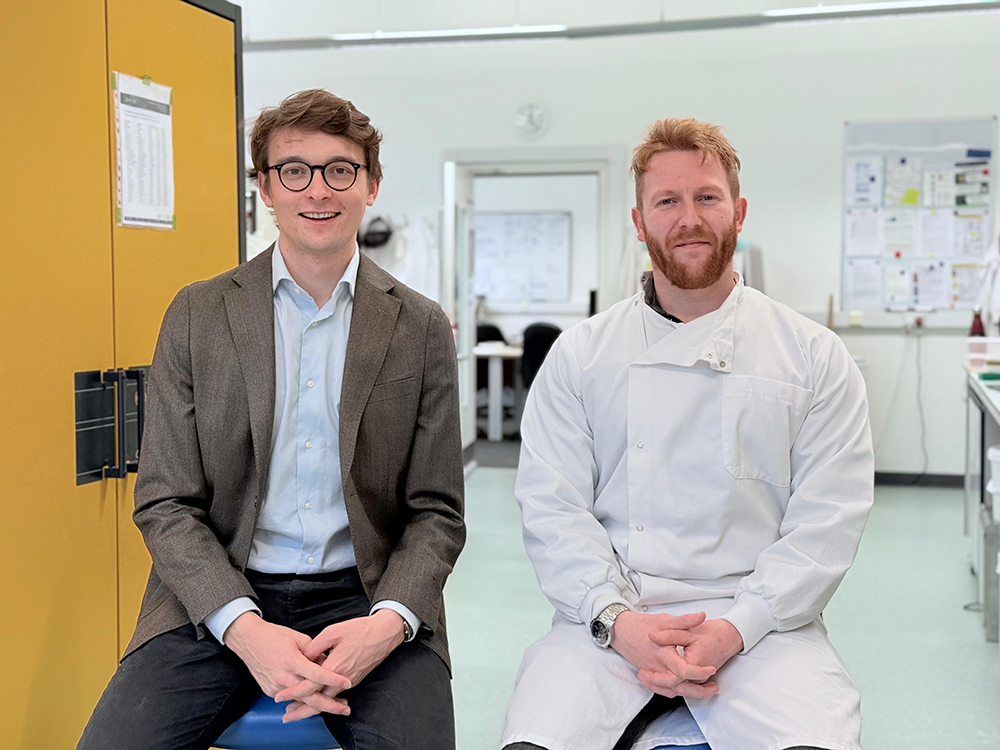
A&B Smart Materials was founded by Amaury van Trappen (CEO) and Dr Benjamin White (CTO).
Amaury holds an MEng in Mechanical Engineering from the University of Bath and an MPhil inManagement from the University of Cambridge.
Ben holds an MChem in Chemistry from the University of Bath and a PhD in Nanotechnology and Smart Materials from the University of Oxford.
A&B Smart Materials won the TBAT Innovation Challenge 2025 and was 2nd runner-up of the 2025 BBIA Demeter Award for the Startup Category at the Royal Society of Chemistry in November 2025.
The company was also selected for the Creative Destruction Lab in Paris (Climate Stream) and for the inaugural EarthScale Accelerator programme.
Key investors include Sake Bosch, Caesar VC, Archipelago Ventures, Living Hope VC, Triple Impact, and the University of Oxford through the Oxford Seed Fund, as well as the cofounder of Wayve.
Nikola Lugonja, of Triple Impact Ventures, said: “The founders’ energy, professionalism and maturity stood out immediately.
“They translated a complex chemical solution into a crystal-clear value proposition and were refreshingly honest about use cases, risks and next challenges. Their bio-based SAPs are already very performant and approaching price parity with fossil-based polymers, despite the company being at an early stage.
“Replacing fossil-based, non-degradable polymers that end up as persistent microplastics in soils and hygiene products is exactly the kind of systems change we want to see.
“Their bio-based SAP technology addresses a timely and substantial market need in the shift away from synthetic microplastics.
“What resonates with us is their ability to deliver a differentiated, sustainable solution using widely available, low-cost inputs and standard production methods.”