





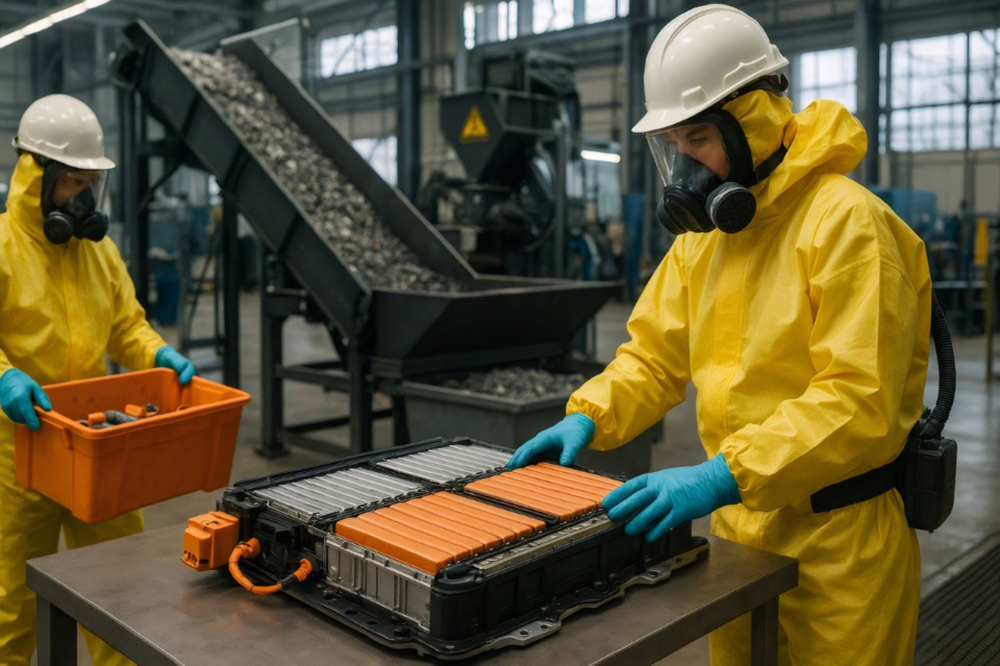
Recycling innovations and graphite recovery are shaping the future of sustainability in the Li-ion battery industry, says John Jaddou, Global Director New Business, Orbia.
Industries worldwide are under mounting pressure to decarbonise. Industrial activity accounts for roughly a quarter of global greenhouse-gas emissions, rising to nearly a third when electricity and heat use are included.
Globally, manufacturing remains one of the largest emitting sectors. In 2021, it was responsible for the highest greenhouse emissions in the EU, totalling 800 million tonnes of CO2-equivalent, which represents 22% of the region’s total emissions. What’s more, the UK alone produces more than 60 million tonnes of CO2 each year.
Many countries are pursuing ambitious net-zero commitments – such as the UK’s goal of reaching net-zero emissions by 2050 – making decarbonisation a central cross-sector priority for the decades ahead.
To achieve these goals, many sectors are embracing batteries – not only in the electrification of vehicles, but also in grid-scale battery storage, renewable energy integration, data centres that are powering AI, humanoid robotics, and other advanced technologies. This widespread focus is driving a rapid increase in demand for lithium-ion batteries.
As expansive battery production is required across sectors to meet the expansion of these industries, it’s never been more critical that we take steps to ensure a reliable and responsible supply of battery energy materials.
The significance of ensuring the reliable supply of graphite
Graphite is one of the key components in modern lithium-ion batteries. It acts as the primary anode material and plays a crucial role in enhancing battery performance, safety, and lifespan.
Currently, more than 95% of the global supply of battery-grade graphite** is supplied by China alone, and with growing demand across a range of global industries, the pressure on those supply chains increases, calling their reliability into question.
A Stanford University-led industry roundtable – held in Washington D.C. early last year – highlighted the urgency in addressing China’s control of global battery-grade graphite supply, citing potential solutions including domestic battery recycling to recover and reuse spent graphite.
To ensure the advancement of industry can continue at the rate we need it to, the energy materials industry must secure domestic, circular, and responsible sources of critical materials such as graphite to reduce risks from export restrictions, tariffs, and geopolitical tensions.
Why we need a responsible, circular supply
There are several ways to produce battery-grade purity in graphite, but many of the traditional methods present further environmental disadvantages.
The natural production of graphite, for example, involves energy-intensive mining, as well as beneficiation and extensive purification. These processes carry notable economic costs and environmental impacts due to land use, water consumption and the need for high-temperature or chemical treatments.
Synthetic graphite, on the other hand, requires extremely high-temperature processing from petroleum-based feedstocks, making it energy and carbon-intensive.
What’s more, most waste graphite from spent batteries or production scrap is incinerated or ends up in landfill, which poses another unnecessary addition to carbon footprints and environmental issues.
Reducing the carbon intensity of graphite production will be just as critical to enabling industry-wide decarbonisation through batteries as securing a reliable supply. This is why regenerating graphite from battery waste is a vital step forward. Initial analysis by Orbia’s sustainability team indicates that recycled graphite can reduce CO₂ emissions by up to 70% compared to conventional materials.
A circular supply of graphite reduces reliance on long-haul imports, helping OEMs meet emerging regional-content rules, sustainability standards, and due diligence requirements. Moreover, with global demand projected to outpace traditional supply by more than 2.5 million tonnes by 2035, it would be irresponsible to depend solely on mined or synthetic sources.
Circular material streams offer a faster, lower-carbon, and more secure path to scale. They transform a cost burden into a revenue-generating product stream, making domestic recycling infrastructure financially viable.
This is an essential step in building a robust, closed-loop ecosystem capable of supporting innovation for decades to come.
Why graphite?
Recycling programs traditionally have relied on lithium, nickel and cobalt, but graphite has been historically overlooked. Complex impurities in black mass residue and a lower perceived value created technical and economic barriers.
However, Orbia’s innovations in purification and regeneration have effectively enabled waste graphite to be turned into high-purity anode-grade material. Advanced multi-stage purification can remove silicates, metals and heteroatom contaminants to meet demanding electrochemical specifications.
This result is the production of regenerated graphite that performs on par with virgin material in cycle life, first-cycle efficiency, rate capability and overall stability.
To ensure that nearly 100% of recovered graphite is utilised rather than discarded, beyond anodes, reclaimed graphite can serve a host of automotive applications, including brake systems, friction materials, thermal management components, conductive polymers, gaskets and EMI shielding.
Reclaimed graphite can be used in nearly 100% of automotive applications, including brake systems, friction materials, thermal-management components, conductive polymers, gaskets, and EMI shielding.
From lab to industry through collaboration
Bringing circular graphite to industrial scale requires the combined contributions of automakers, battery manufacturers, recyclers, and materials innovators.
Validation programs with OEMs and cell manufacturers ensure regenerated graphite meets stringent performance requirements. Collaboration with recyclers secures consistent feedstock quality from black mass, production scrap, and end-of-life batteries. Engagement with policymakers helps align domestic-content incentives, battery-passport frameworks, and sustainability standards.
Businesses seeking greater resilience are forming closed-loop partnerships to route waste materials back into the supply chain, while pilot and pre-commercial lines demonstrate readiness for regional manufacturing.
The move toward electrification demands more than advanced technology – it requires a new mindset about materials. Recovering graphite offers a practical, scalable, and environmentally critical solution for enabling clean mobility.
Innovators in industries such as technology, automotive, and energy storage can reduce emissions simply by turning spent batteries into new energy materials, strengthening supply chains and unlocking the full value of their resources.
The future will not be defined solely by how vehicles are powered, but by how responsibly the materials inside them are sourced.
Sources:
https://docs.google.com/document/d/17gA_AKEkbmUv2yxU758IzMF1BSAUmiHa/edit
https://www.batterytechonline.com/battery-recycling/orbia-s-breakthrough-in-graphite-recycling-for-battery-materials
https://www.orbia.com/this-is-orbia/news-and-stories/graphite-recycling-megatrendsetters/#:~:text=A%20Looming%20Supply%20Chain%20Crisis,is%20fully%20dependent%20on%20China.
*https://www.theecoexperts.co.uk/news/top-7-most-polluting-industries
** https://energy.stanford.edu/news/confronting-chinas-grip-graphite-batteries#:~:text=China%20controls%20more%20than%2095,weight%20in%20lithium%2Dion%20batteries.