




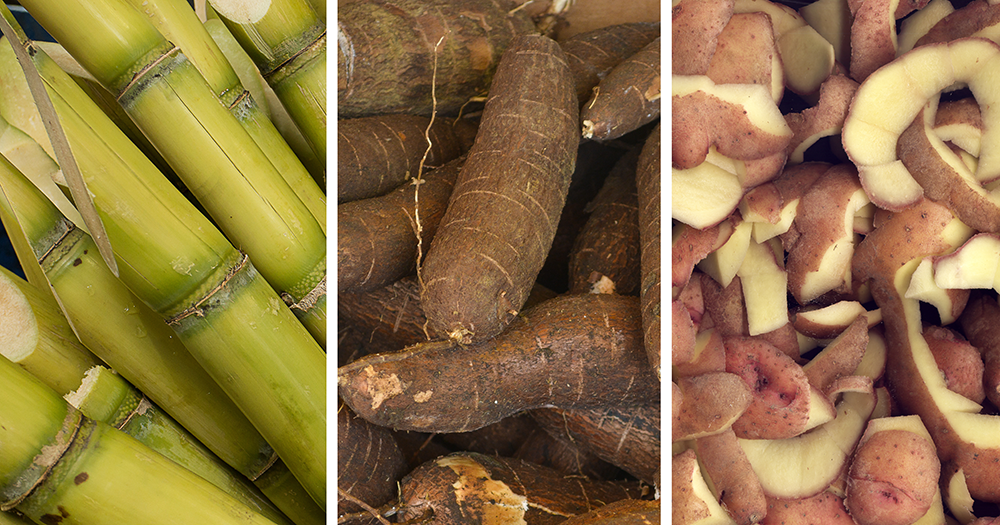
Teysha Technologies wanted to solve a basic problem, says chief science officer Professor Ashlee Jahnke. While plastics are capable of incredible mechanical performance and useful in every aspect of our daily lives, its waste is an environmental scourge. KarmaCane, a patented sugar-based polycarbonate made from renewable sugars derived from waste such as sugar cane bagasse, cassava and potato peels, is our answer.
The polymer is strong and durable during use, then breaks down into environmentally benign products such as sugars and carbon dioxide at the end of its useful life. Utilising a plug-and-play type platform design means that we can create a full family of polymers with properties tailored for individual applications.
Modular Chemistry: From Rigid to Flexible
KarmaCane is built on a modular chemistry that allows for tuning of the stiffness, toughness and lifespan of the polymer.
By adjusting the ratios and structures of the saccharide monomers in the carbonate backbone, we can match the performance of materials ranging from rigid moulding grades similar to ABS to flexible films similar to PET.
Small changes in the formulation shift the material from a solid pellet to a flexible sheet or a liquid coating. We also set the degradation rate at the design stage. Long-life versions stay stable for years. Short-life versions biodegrade in weeks or months. This tuning of mechanical behaviour and end-of-life performance sets KarmaCane apart from standard bioplastics, which often offer only one profile and limited durability.
Real-World Pilots: Eyewear and Packaging
KarmaCane has already been tested in tough conditions. We produced sunglass frames and sent them on a successful Mount Everest summit. They handled extreme cold and UV without cracking. This gave us confidence that a biodegradable polymer can support high-performance outdoor products. In packaging, it is being trialled as a coating for paper and cardboard for use in cups, trays and boxes, allowing the barrier performance of a plastic lining while remaining compostable at home. These pilots highlight its performance across a range of applications, from rigid parts to thin coatings.
Scaling Up: Global Production and Prototyping
We are now preparing for commercial scale. KarmaCane runs on standard plastics equipment and has been validated for extrusion, injection moulding and roll-to-roll coatings. Early production runs are energy-efficient with competitive cost at volume.
Renewable Feedstocks and Circularity
KarmaCane sources its sugars from waste streams, extracting them from potato peels, cassava skins and other agricultural by-products. These sugars form the basis of our polymers, removing the need for virgin crops or fossil feedstocks. These waste resources provide stable, local supply chains and let us convert carbon that would otherwise be discarded into functional plastic materials. Remaining fibres from the sugar extraction process can be used as biodegradable fillers or composted. The result is a genuinely circular feedstock model that aligns with EU ambitions for waste-to-value biorefineries.
Certifications and Compliance
We designed KarmaCane to meet strict biodegradability and safety standards. In OECD 310 testing, it achieved certification, breaking down into water, carbon dioxide and natural product residues. Working with external testing houses, we are currently conducting food-contact and packaging compliance assessments and will advance submissions to FDA and EU regulators for food and drink applications. The chemistry design suggests that it will meet migration and purity standards, as its degradation produces only non-toxic by-products.
Commercial Engagement
KarmaCane is now progressing into market pilots. Personal care companies are testing it as a replacement for microplastic additives such as beads, thickeners and stabilisers. Because the material degrades after its useful lifetime, it has the potential to eliminate several thousand tonnes of plastic microbead waste each year. Packaging and consumer goods companies are trialling it in rigid parts and barrier coatings. These trials span homewares, food packaging, electronics and medical components. The commercial pull is clear, as companies need plastics that meet climate and regulatory requirements without losing performance.
Compostables and the Circular Economy
KarmaCane offers a way to design plastics with a controlled and predictable end-of-life. Single-use versions can biodegrade in months, helping to avoid contamination of recycling systems and reducing environmental burden, while long-life versions support applications that need durability. This flexibility fits with current UK and EU policy trends, including proposals that target long-lasting polymer pollution. Materials that are engineered to break down by design support more effective composting, recycling and waste management. They help brands meet circularity targets without the usual trade-offs between performance and environmental safety.
A Sustainable Materials Revolution
I am proud of what our team has achieved. KarmaCane shows that industry no longer has to choose between functional performance and environmental responsibility. We now have a family of polymers that perform like conventional plastics but return to nature at the end of their service life. The pilots have proven the concept, the manufacturing base is taking shape, and with continued investment and clear regulation, materials like KarmaCane can form the backbone of the next generation of sustainable products. My view is simple: If a material can do its job and then safely vanish, that is the future we should build towards.