





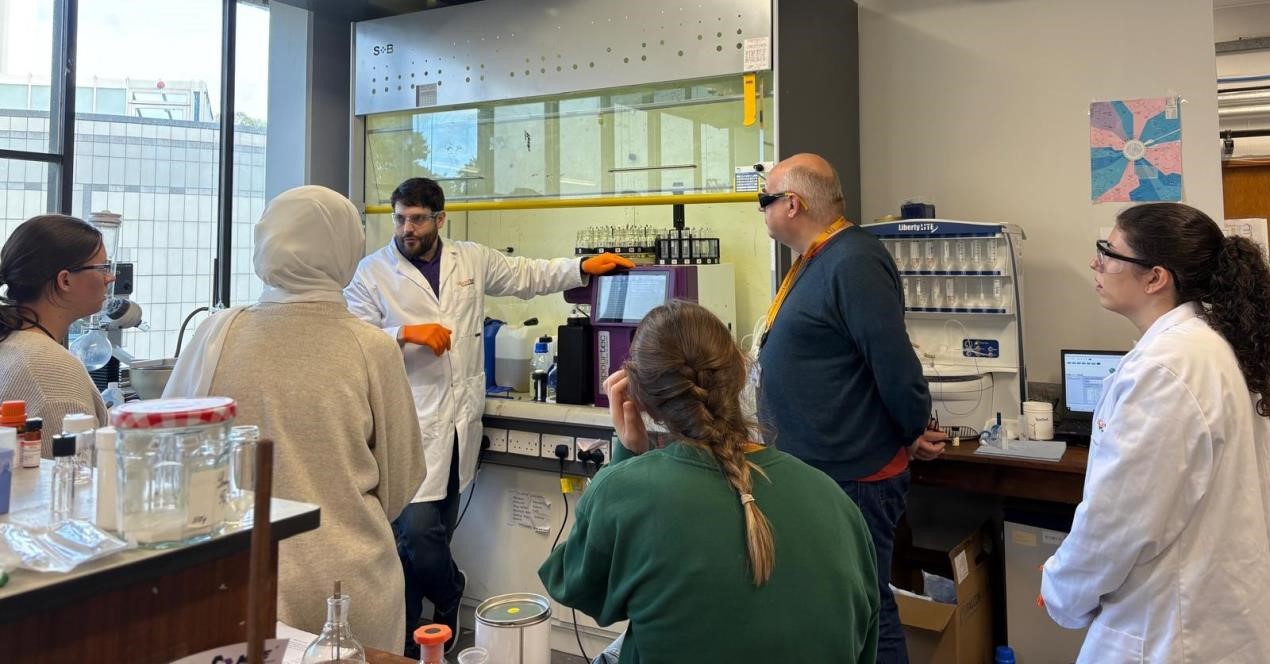
Flow chemistry experts Vapourtec stayed close to home with the first installation of their pioneering production Peptide-BuilderTM system at the University of East Anglia in Norwich.
The system, the result of years of research and development in close liaison with peptide scientists around the world, offers the potential for far-reaching, new pharmaceutical peptide discoveries.
Advancing Peptide Synthesis through Flow Chemistry
Traditional batch-based solid phase peptide synthesis (SPPS) methods can be time-consuming, prone to inconsistencies and often lack comprehensive data tracking.
Vapourtec’s system applies continuous-flow principles to overcome these limitations, offering researchers faster, more reliable, and fully traceable syntheses.
Following installation on campus, Vapourtec’s Chief Scientific Officer Dr Manuel Nuño led a two-day hands-on training session with Professor Searcey and Dr Andrew Beekman’s teams. The training covered:
• Operation of the fast-flow SPPS platform
• Sequence generator software
• Use of in-line UV/Vis monitoring and real-time peptide volume tracking
• Utilization of the system’s open access capabilities
• Ability to queue up to 16 peptides at any time
To demonstrate performance, three peptides – a 16-mer, 23-mer and 35-mer were successfully synthesised.
Each synthesis accompanied by a comprehensive PDF report detailing FMOC deprotection profiles and aggregation events. These reports illustrate the progression of each synthesis, providing peptide scientists with valuable real-time insights to optimize their processes, saving both time and materials.
Professor Searcey said: “We are very excited to begin using the Peptide-Builder in our research. The ability to monitor synthesis in real time, obtain detailed reaction data and queue up to 16 peptides for automated synthesis will be a great addition to our peptide synthesis workflow.”
The Peptide-Builder is a compact, fully automated, lab-scale synthesizer developed to advance solid-phase peptide synthesis (SPPS) through cutting-edge flow chemistry. It enables rapid, high-purity, high-yield peptide production with full automation and open-access functionality, making it ideal for academic and industrial research environments.
Dr Manuel Nuño added: “Seeing the first Peptide-Builder in operation at UEA is a proud moment for the Vapourtec team. This technology represents the culmination of years of development and close collaboration with peptide scientists.
We look forward to seeing how Professor Searcey’s group will apply the system in designing peptides that target complex biological structures”.
Professor Searcey’s research group will integrate the Peptide-Builder into ongoing programmes focused on the design of novel peptides that modulate DNA structural motifs and protein–protein interactions, aiming to contribute to the development of anticancer, antimicrobial and anti-inflammatory therapeutics.