




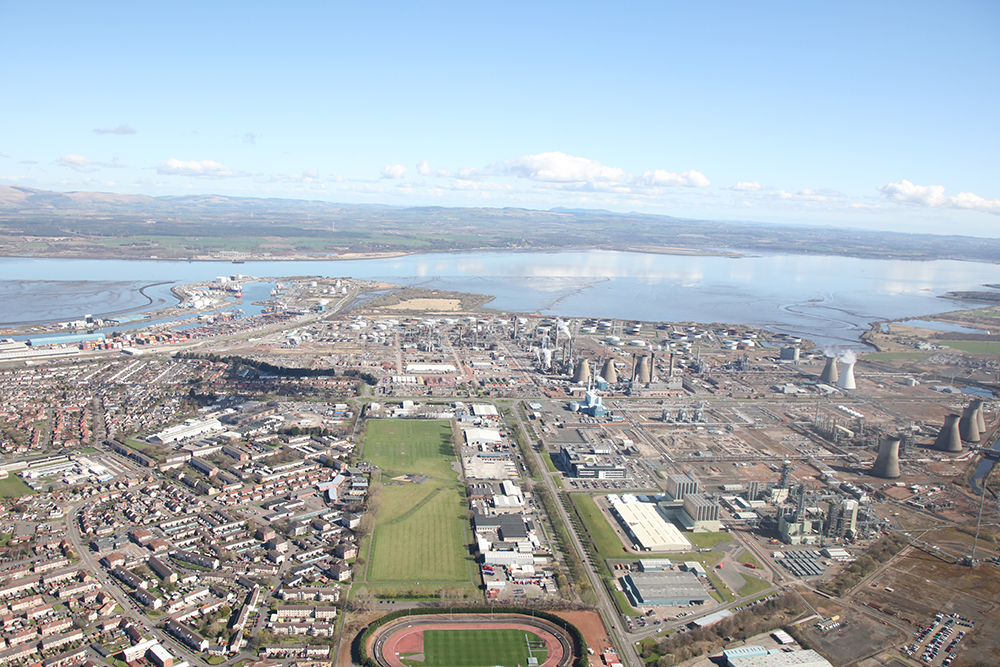
INEOS has invested £150m in the long-term future of its Grangemouth site, with support from the UK government.
Viewed as a critical hub for national manufacturing and energy sectors – and one of the UK’s most important industrial assets – funding includes a £75m government loan guarantee and £50m grant.
The investment will upgrade key production units, improve energy efficiency, reduce emissions, and enhance the site’s competitiveness.
Grangemouth is the UK’s last ethylene plant, supplying the essential raw materials for plastics used in advanced manufacturing, sustainable technologies, and the automotive and aerospace industries.
The investments will also secure more than 500 highly skilled direct jobs.
Ineos chief executive Sir Jim Ratcliffe said: “The £150m investment in the future of a major UK industrial site demonstrates INEOS’ commitment to British manufacturing. The support of the UK Government is welcome.
“However, we need to continue to work together to deliver competitive and efficient low-carbon manufacturing for the UK, long term.
“The answer is NOT decarbonisation by deindustrialisation. Without a strong manufacturing base, the economy will continue to decline.
“High energy costs and punitive carbon charges are driving industry out of the UK at an alarming rate. If politicians want jobs, investment and energy security, then they must create a competitive environment.”
He added: “The UK government’s intervention at Grangemouth is a timely and welcome recognition of the need to maintain our core manufacturing capability in the UK and I want to thank them for their support for this vital UK infrastructure.
“Grangemouth is hugely important both economically and strategically. We need jobs. We need home production. We need national security which we lose if we can’t run hospitals or make armaments or transport food.
“The government’s support for Grangemouth is a great start but is only a start in reestablishing a competitive manufacturing base for the country.
“We now MUST scrap carbon taxation, the most idiotic tax in the world. It simply squeezes the life out of home production as there is no cash left for investment and we end up replacing home produced goods with imported products from places that still burn coal! An utterly ridiculous tax that kills industry and increases global CO2 emissions.
“Furthermore, we need an energy strategy that provides competitive energy costs to industry and we must maximise our output from the North Sea which still has abundant reserves. If the government simply applied corporation tax rates to North Sea production, investment would rise and output would grow.”
Scottish Secretary Douglas Alexander added: “This is a landmark moment for Grangemouth. This £120 million UK Government investment protects not just the 500 jobs at the plant, but hundreds more across Scottish supply chains. We have been clear that we will do everything possible to secure the long-term future of the Grangemouth site.”
An INEO spokesman highlighted that, while two-thirds of British manufacturing has disappeared in the last 25 years alone, the UK population has risen by more than 10 million, and that demand for the foundational materials that critical sectors depend on will not subside. Without domestic manufacturing capacity they will need to be imported, often at a higher cost while delivering no economic or environmental benefit.
The programme of investments at Grangemouth forms part of a broader INEOS strategy to invest in modern, efficient, lower-emission industrial facilities across its portfolio. It reinforces INEOS’ long-term commitment to operating world-class assets in the UK.
Ratcliffe calls for Europe’s politicians to act now and save the chemical industry
Sir Jim Ratcliffe has called on Europe’s politicians to take immediate and urgent action to halt the catastrophic decline in the European chemical industry and protect Europe’s economy from a total reliance on imported goods.
“There is not going to be much left of chemicals in Europe unless politicians get to grips with it very soon.”
He said: “We now have huge levels of Chinese imports coming into Europe for two reasons. Firstly, President Trump’s actions have pushed them out of the US and so it is now all coming here, and secondly, China has vastly overbuilt capacity. No Chinese company is making money and all this product is finding its way into Europe at ‘dumping’ prices.”
Sir Jim commented that he has never seen trading this bad, even in the downturn of 2008. He added, “Chemicals, a one trillion Euro industry, cannot survive without tariff protection IMMEDIATELY alongside action on crippling and absurd carbon taxation. Energy prices are four times higher in Europe than in the US and that is totally unsustainable.”
Ineos says that the net result of this ‘disastrous’ European policy is a tsunami of closures of major chemical facilities across the continent of Europe (see attached table). In the five-year period from 2022 to 2027, 90 facilities have either closed or have announced closure with a loss of almost 25 million tonnes of capacity. These plants would all cost €1billion to replace so a loss of almost €1 trillion from Europe’s asset base.
Sir Jim concluded: “This data is clear evidence of decline that can no longer be ignored by the politicians. Someone needs to wake up before the entire industry is gone, leaving Europe dependent on China for the core materials that support defence, healthcare, food and manufacturing. We need action now.”