




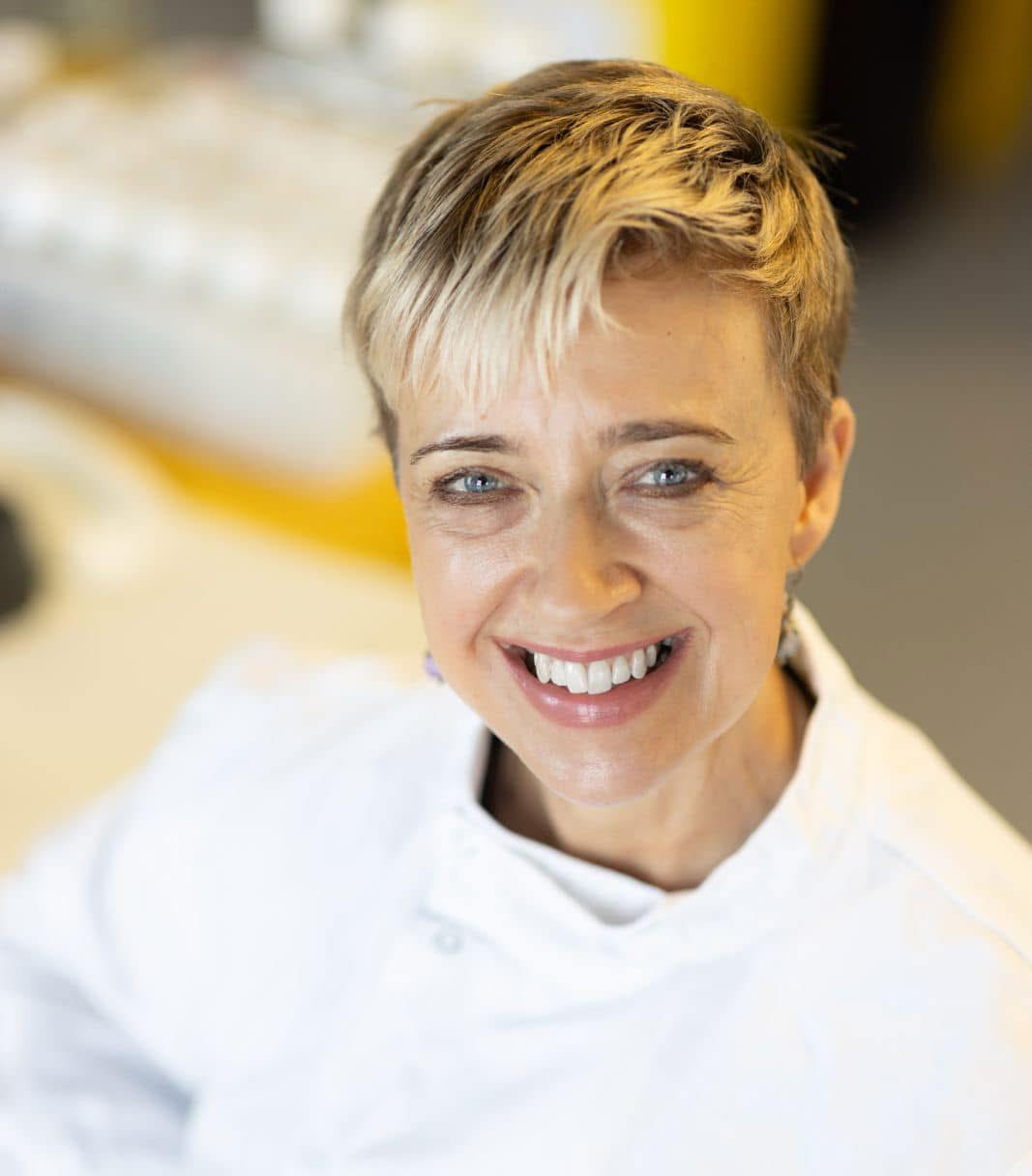
Biology came to Carol Treasure through childhood walks in the countryside with her father, a passion she carried into a Physiology and Pharmacology degree from the University of Sheffield. But her resolve crystallised in the pharmaceutical industry, where she first witnessed animal testing firsthand and concluded there had to be a better way – not just ethically, but scientifically. That conviction shaped her PhD at FRAME (the Fund for the Replacement of Animals in Medical Experiments) at the University of Nottingham, and it has defined every professional choice since.
Her understanding deepened running the European operation of US-based company Cascade Biologics, providing human cell culture systems to scientists globally, and contributing to development of some of the world’s first animal-product-free cell culture systems, to maximise the human-relevance of the models. There she also gained valuable commercial experience, building the confidence needed to found XCellR8 in 2008, with a mission to accelerate the world’s transition to 100% animal-free testing.
When XCellR8 launched, demand for animal-free testing was limited. Clients were early adopters, brands whose values aligned with cruelty-free cosmetics. To survive, she supplemented income through training – teaching hundreds of scientists in cell culture methods – but she never wavered on a core principle: she would never offer animal testing or revert to the use of animal-derived materials, no matter the financial pressure. She believed the industry would eventually catch up.
Two tipping points accelerated that catching up. The EU ban on animal testing for cosmetics, fully implemented in 2013, brought recognition for animal-free science. Around the same time, in vitro methods were gaining full acceptance as OECD Test Guidelines. By 2013, XCellR8 achieved GLP accreditation alongside the Lush Prize for Training, in recognition of its work educating the next generation of scientists. A key strategic partnership with Lush fuelled the company’s growth and XCellR8 became established as a leading in vitro testing lab, built on the unique combination of leading science alongside its ethical approach.
The market has begun to follow. Innovate UK and Horizon 2020 backed further research into acute toxicity and skin irritation testing. The UK government published its “Replacing Animals in Science” strategy in November 2025, and Parliament debated reform in Spring 2026 with visible frustration at the slow pace of change. Dr Treasure met with senior politicians including Sir Keir Starmer, Rachel Reeves, Steve Reed and Baroness Sue Hayman to discuss the economic case for animal-free science.
Yet even with regulatory animal-free tests now widely used in Europe, Dr Treasure notes that some organisations remain reluctant to change their testing strategy. The shift is not automatic. “Animal tests have become the benchmark due to years of use, not because of their reliability,” she says. “Historic animal test data is simply not as accurate as modern in vitro technologies. The tide is only going in one direction. Companies face a decision to go with it, or risk being left behind.”
Eighteen years from launch to mainstream adoption is a long time to stay the course. But Dr Treasure has the data, the client base and a determination not to settle for the status quo, showing it was worth the wait.
For more information, please visit x-cellr8.com.