




Across the chemicals, fertilizers, and petrochemicals sectors, producers face mounting pressure to reduce operating costs and carbon emissions, while maintaining the reliability and throughput that global markets demand.
For many of them, this is prompting close examination of some of their most energy-intensive assets, including the compressor trains central to petrochemical, ethylene, industrial gas, and fertilizer production.
A significant proportion of these systems still rely on gas or steam turbines that have operated reliably for decades – albeit powered by fossil fuels.
However, with increasing energy cost volatility and regulatory and commercial pressures to improve operational performance, turbine-to-electric conversion is moving higher up the agenda.
Rather than replacing equipment like-for-like, electrification provides an opportunity to address several strategic challenges at once: reducing energy losses, improving operational flexibility, managing lifecycle costs, and lowering carbon emissions.
Improving efficiency where it matters most
Specifically for chemical producers looking to improve competitiveness, the efficiency of rotating equipment is a logical place to start.
Compressors associated with feedstock processing, refrigeration systems, gas handling, and product recovery consume substantial amounts of energy over their operating lives. Even modest improvements in efficiency can have a meaningful impact on operating costs.
ABB’s Top Industrial Efficiency (TIE) option – a contractual commitment to deliver equipment with the highest possible energy efficiency, without compromising reliability or specification compliance – typically improves efficiency from around 98.5% to 98.7-98.8% for large synchronous machines (motors and generators).
While seemingly marginal, this ~0.2% increase compounds into significant lifetime savings and could unlock billions in value for industry globally according to the firm’s analysis.
Traditional gas and steam turbines have served these applications effectively for many years, but they are constrained by the inherent efficiency limits of combustion-based energy conversion.
In steam turbine applications, flexibility is often limited by the responsiveness of the steam generation system, which may not adjust output as quickly as process demand changes.
Gas turbines offer greater operational flexibility, but their performance can be affected by ambient de-rating, which reduces available output and efficiency under certain conditions.
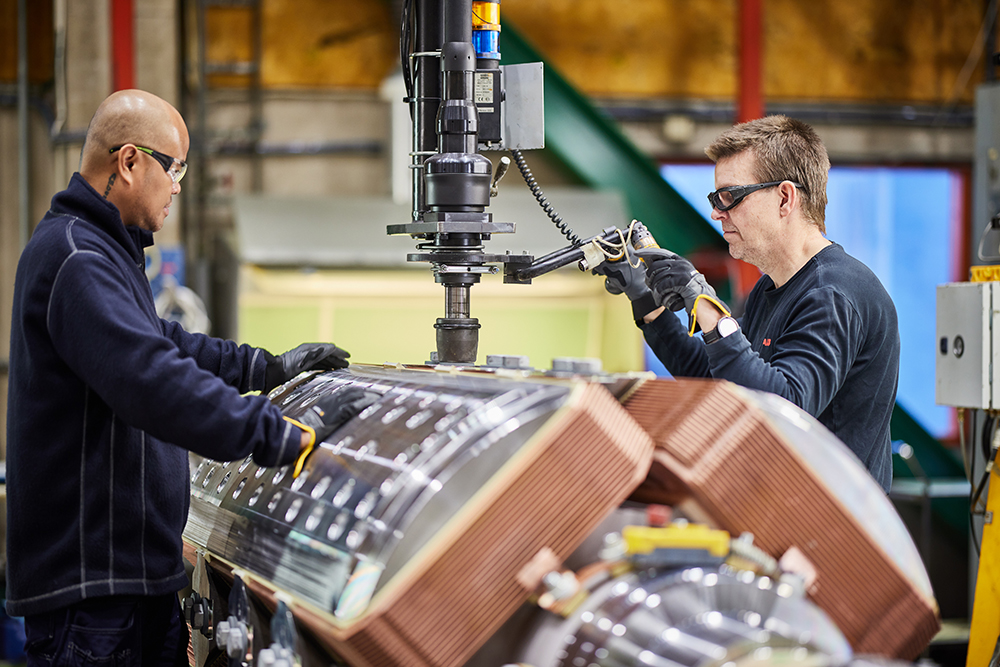
High power electric motors paired with variable speed drives offer an alternative approach. Variable speed drives continuously regulate voltage and frequency, enabling motors to deliver exactly the speed and torque required at any given moment.
This allows operators to align motor output directly with process demand, rather than relying on mechanical control methods such as throttling valves or bypass loops to manage variations in throughput.
By converting a greater proportion of input energy into useful mechanical work, electric drivetrains help generate more value from existing assets. Over thousands of annual operating hours, these efficiency gains accumulate.
Why petrochemical producers are paying attention
The opportunity is especially relevant in ethylene production, one of the most energy-intensive segments of the chemical industry. Pyrolysis gas, propylene, and ethylene compressors are major sources of energy consumption.
Producers are therefore focusing their electrification strategies on assets like these to help reduce fuel consumption and improve efficiency.
Recent projects illustrate how this transition is taking shape. In China, Shenyang Blower Works and ABB collaborated on the conversion of an ethylene compressor from steam turbine operation to an electric motor and variable speed drive system, forming part of a broader strategy to reduce energy consumption for a local petrochemical company.
While every facility has its own technical and economic considerations, projects like these demonstrate that electrification is now a practical reality in large-scale chemical manufacturing.
Strengthening resilience and reducing lifecycle costs
While energy efficiency is a primary driver for electrification, resilience is becoming equally important. In large chemical and petrochemical facilities, the consequences of an unplanned compressor outage can extend well beyond a single asset.
Production interruptions and process instability can create significant operational and financial costs. As a result, producers are evaluating technologies not only on efficiency, but also on reliability and long-term asset performance.
Electric drivetrain systems help meet these objectives through simpler mechanical architectures and enhanced operational visibility.
Modern drive systems offer precise torque control, rapid response to disturbances and features such as encoderless operation that reduce mechanical complexity. Soft starting and controlled acceleration further reduce stress on compressors and rotating equipment, extending asset life and lowering maintenance requirements.
Combined with condition-monitoring and diagnostic capabilities, operators gain real-time insight into energy consumption and equipment condition. This helps reduce unplanned downtime and manage lifecycle costs more effectively.
Electrification also provides flexibility in how facilities source and manage energy. Unlike turbine-driven systems tied to a dedicated fuel supply, electrified operations can draw power from grid electricity, onsite generation, energy storage and renewable sources.
As energy systems continue to evolve, this flexibility will be increasingly valuable for producers navigating market uncertainty and decarbonisation requirements.
Realising these benefits, however, requires more than simply replacing one prime mover with another. Electrified systems can be engineered as integrated drive systems – combining motors, drives, transformers, and control infrastructure into a coordinated architecture tailored to the application.
This integrated approach helps maximise the value of available electrical capacity while simplifying system design and providing a strong foundation for future expansion and digitalisation.
An opportunity to optimise legacy assets
One of the often-overlooked benefits of turbine-to-electric conversion is that it can prompt a wider review of existing equipment. Many compressor systems currently operating in chemical facilities were designed decades ago and may no longer be optimised for current or future production requirements.
Electrification projects present a natural opportunity to reassess equipment performance and capacity needs, rather than replacing ageing assets on a like-for-like basis.
Compressor re-rating can form part of this process. Advances in aerodynamic design, materials, and manufacturing techniques have improved compressor performance considerably in recent decades.
Upgrading components such as impellers, diffusers, seals, and bearings can improve efficiency, reduce power demand, and enhance reliability, while extending the operational life of existing assets.
Lower power requirements can also reduce the size of the motor and drive system needed for conversion, helping to improve project economics. In this context, turbine-to-electric conversion forms part of a broader effort to optimise existing assets and improve how they perform over time.
Looking ahead
For decades, turbine-driven systems made sense because of the economics and energy infrastructure in which they operated. Today, that landscape is changing. Rising energy costs, aging assets, and evolving energy markets are prompting producers to rethink long-established assumptions about how critical equipment should be powered.
For operators facing aging infrastructure and increasingly dynamic production demands, electrification is not just a technical upgrade – it is a strategic enabler for long-term performance, resilience, and operational control.