





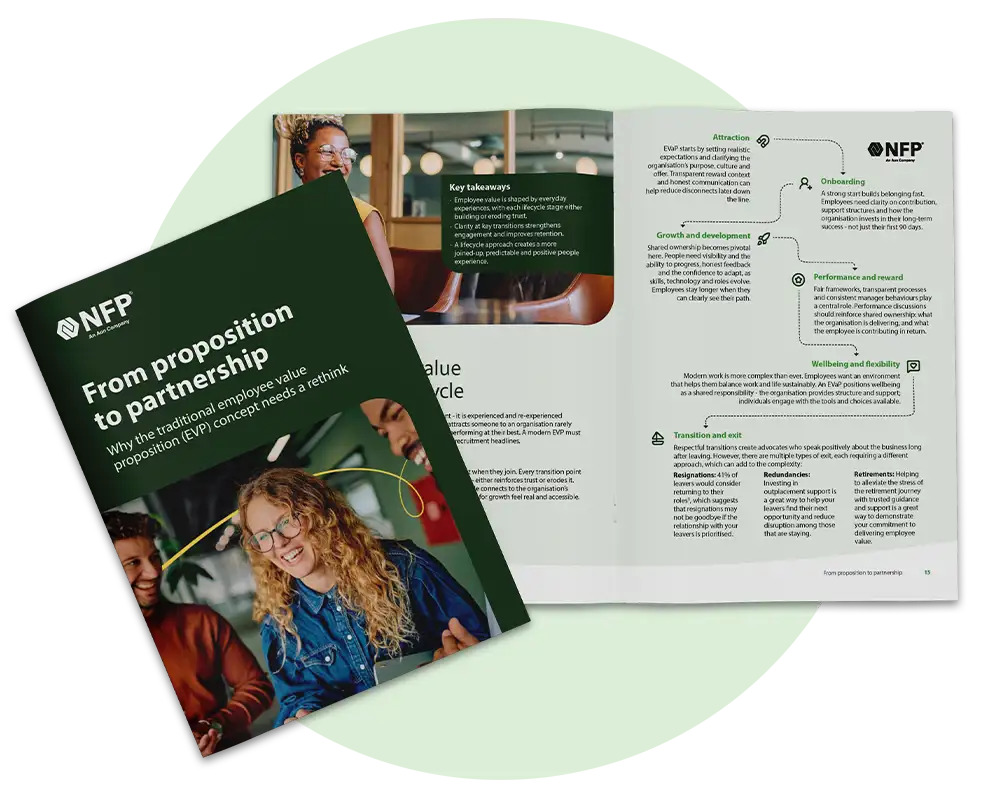
Support for working parents has often been seen as a “nice to have”. For chemical employers, that view no longer fits the world they are operating in. Many businesses are dealing with high energy costs, changing regulations, supply chain pressure, sustainability goals and ongoing skills shortages. In this environment, every action that helps keep good people matters. Supporting parents is now a key part of a strong Employee Value Proposition (EVP) and a practical way to build business resilience.
KEY TAKEAWAYS
- Chemical employers need to protect scarce skills, knowledge and operational continuity.
- Parental support makes your EVP more credible in high-pressure, safety-critical workplaces.
- A shared, life-stage-aware EVP helps build trust, retention and resilience.
EVP is not just an HR topic. In the chemical sector, it is closely linked to productivity, safety, innovation and the ability to keep operations running well. Employers are under pressure from rising raw material, import, export and energy costs. They are also dealing with complex regulation, investment uncertainty and concerns about whether they can attract and keep the skills they need.
That is why support for working parents should not sit on the edge of people strategy. Parents may be managing childcare gaps, rising costs, school demands, health needs, neurodiversity assessments and unexpected family issues. These pressures affect whether skilled operators, engineers, scientists, technical specialists, shift leaders, compliance professionals and commercial teams can stay, progress and do their best work. In a sector where knowledge, continuity and trust matter, a more human and practical EVP can become a real advantage.
- Balancing work with parenthood is the new norm
Parenting is not a one-off event. It is not always neat, planned or easy to predict. This matters in chemical businesses, where production schedules can be fixed, compliance demands are high and many roles need specialist knowledge built over many years.
- Early-career parents may be balancing childcare availability with rising living costs and shift patterns.
- Mid-career parents may be managing school schedules, health appointments or caring responsibilities while leading teams or projects.
- Later-career employees may be supporting children, young adults and ageing relatives while carrying deep technical expertise.
It is also harder than ever to assume when people will become parents. Some do so early in their careers. Others do so later, often while already holding senior, technical or leadership roles. Many return to work in different ways and continue to manage family responsibilities alongside demanding jobs.
Yet many EVP strategies still seem to be built around a “standard” employee with predictable needs. In chemical manufacturing, distribution, formulation, laboratories and support services, this can create a retention risk. Modern EVP design needs to recognise parenting as part of working life, not as an exception to it.
- Supporting working parents is a real test of EVP authenticity
Policies, benefits, flexibility and manager behaviour show employees what a culture is really like. This is especially true in safety-critical and regulated workplaces, where trust and consistency are vital. Parenting pressure points often show whether an EVP is real or just words on a page:
- Child illness that happens repeatedly
- School closures, strikes or holidays
- Childcare breakdown at short notice
- Neurodiversity or health assessments
- Family wellbeing issues colliding with workload demands
These are the moments when culture is felt most clearly. If employees cannot rely on support when parenting pressures are at their highest, the EVP loses credibility. In an industry competing for technical, scientific, engineering and commercial talent, people can quickly spot the difference between a policy that exists on paper and support that works in real life.
- Shared ownership: The future of supporting parents at work
One of the biggest shifts in EVP thinking is the move away from a top-down approach. Parenting support is a good example of why this matters. A central policy may set the direction, but the everyday experience is shaped by managers, shift patterns, project deadlines, customer needs and local team culture.
Shared ownership means:
- Co-designing policies with parents, carers and operational leaders
- Balancing flexibility with safety, compliance and continuity
- Encouraging employees to articulate what good support looks like
- Creating transparent frameworks that reduce inconsistent manager decisions
- Recognising parenting as part of a healthy, high-performing workforce
- Building accountability on both sides for sustainable working practices
This is the idea behind an Employee Value Partnership: a shared model where the employer and employee both have a role to play. It values people’s whole lives, not just their job output. For chemical employers, it also makes flexibility more realistic. Not every role can be remote. Not every shift can change at short notice. But every organisation can create clearer expectations, better planning, more understanding managers and fairer access to support.
- Supporting parents strengthens organisational resilience
Talent strategy and support for carers are often treated as separate topics. They shouldn’t be. The UK chemical sector is being asked to do more with less. Employers need to manage cost pressure, respond to regulation, make progress on decarbonisation, keep operations safe, adopt new technology and protect supply chains. None of this is possible without people who have the capacity, confidence and motivation to perform well.
When organisations support working parents effectively, they unlock key resilience levers:
- Stronger retention of critical skills: experienced employees are more likely to stay when they feel supported through demanding life stages.
- Higher engagement and productivity: people can focus more effectively when work and family pressures are managed openly.
- Greater adaptability across life stages: employees can continue contributing as their circumstances change.
- Reduced recruitment costs and continuity risks: organisations hold on to institutional knowledge and reduce avoidable turnover.
- A more future-proof workforce: support becomes part of how the business adapts to demographic, economic and operational change.
The better the support for working parents, the stronger the organisation’s ability to cope with change. For chemical employers, this is not about lowering standards. It is about protecting the people and skills that help keep standards high.
- A “hire to retire” EVP design matters more than ever
Parenting responsibilities do not fit neatly into one career stage. That is why EVP design needs to look at the whole employee journey. In the chemical sector, this matters even more because workforce planning is already under pressure from retirements, skills gaps, digitalisation, automation and the move to lower-carbon operations.
Key questions for chemical employers include:
- Do new hires understand the real culture around flexibility and support?
- Are managers trained to lead parents with empathy, clarity and consistency?
- Are shift, site and project-based roles included in flexibility conversations?
- Do performance conversations value output, safety and contribution, not simple presence?
- Is parental support applied consistently across sites, functions and seniority levels?
- Do leavers become advocates because they felt supported at critical moments?
A lifecycle-led EVP builds trust and makes support easier to understand. Both are important for working parents dealing with changing demands. They are also valuable in an industry where stability, safety and long-term capability matter.
- It helps you stand out in the race for talent
The organisations that will win the next era of talent will be those that accept a simple truth: employees are whole people. And if family life is part of life, it must be part of work.
For chemical employers, this is about more than being seen as “family-friendly”. It is about building an EVP that reflects the reality of modern work: scarce skills, rising costs, complex regulation, sustainability targets, digital change and the need for resilient supply chains. Supporting working parents is not simply a perk or a gesture of goodwill. It is a clear sign of whether an organisation’s values are lived in practice.