





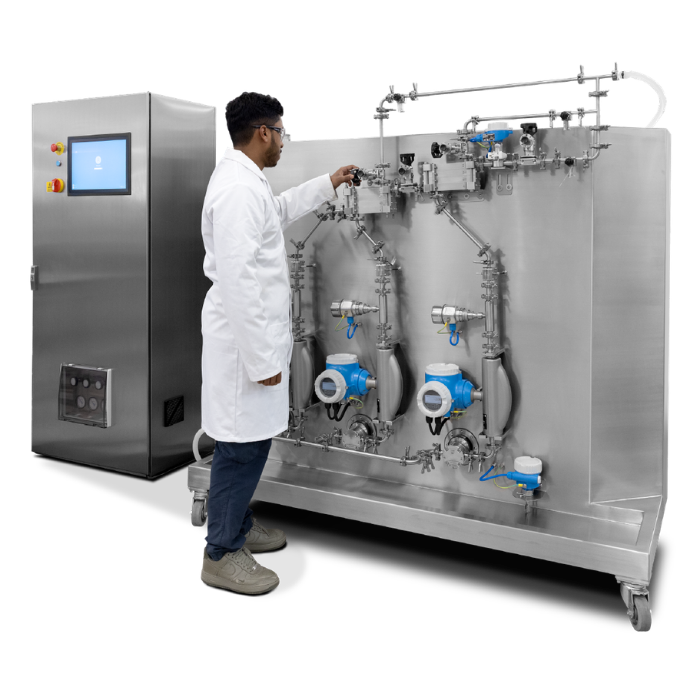
Micropore Technologies has identified several recurring challenges in the scale-up process. By understanding these common mistakes, manufacturers can implement more reliable strategies to ensure consistent particle engineering from development through to manufacturing.
In the pharmaceutical and specialty chemical industries, complex emulsions – such as water-in-oil-in-water (W/O/W) double emulsions, microspheres, and encapsulated fragrances – are notoriously difficult to move from the laboratory to commercial production.
While a formulation may perform perfectly at a 50mL scale, increasing that volume often necessitates manufacturing trade-offs that compromise product integrity, triggering lengthy re-optimisation processes to resolve.
Inconsistent energy distribution across large volumes
One of the most frequent hurdles in scaling is the reliance on high-shear mixing to achieve small droplet sizes. While high-shear homogenisers are effective in small batches, they create inconsistent energy profiles when the volume increases. The material near the mixing head is subjected to intense energy, while material further away is under-processed. This leads to a broad particle size distribution and inconsistent results.
By contrast, crossflow mixing enables uniform droplet formation in a low-shear laminar regime. This approach ensures that every particle is created under identical physical forces, regardless of whether the batch is 10mL or 100L. By using shear force as the driving critical quality attribute (CQA), the formulation principles discovered in the R&D phase transition seamlessly to scale up.
Material waste and the risk of batch failure
In the development phase, a minor variance or an off-specification test batch is easily discarded and managed. However, during full-scale production, poor control over high-energy mixing introduces a significant risk of material waste. Because traditional high-shear mixers apply uneven energy profiles, fluids can easily become over-processed or under-processed within the same vessel. This imbalance can tear the emulsion apart or leave oversized droplets that fail quality control, ultimately leading to the loss of the entire production batch.
To address this, manufacturers require a system that ensures uniform energy distribution. Transitioning to continuous, low-shear processing platforms ensures that the formulation is processed uniformly in a single pass. By eliminating the risks of over- and under-processing, this approach protects sensitive components, prevents costly batch-scale failures, and significantly increases overall manufacturing yield.
The requirement for constant process re-optimisation
A common mistake is treating scale-up as a series of re-inventions. Often, when a process is moved to a larger vessel, the fundamental physics of the mixing changes, requiring engineers to spend weeks or months re-tuning flow rates and concentrations to match the original laboratory results.
The key is adopting technology that allows for a more straightforward scale-up. Rather than re-engineering the mixing process for different volumes, scale-up can be achieved simply by running for longer with a continuous process. This approach ensures that the conditions at the point of particle formation remain identical from the benchtop to the production scale. This effectively eliminates the need for costly and time-consuming process re-optimisation, as the core mixing dynamics do not change with the size of the batch.
Product degradation due to mechanical stress
Many complex emulsions encapsulate sensitive payloads, such as volatile oils or delicate proteins. A recurring issue during scale-up is the degradation of these ingredients caused by the mechanical stress of traditional emulsification equipment.
High-shear methods can generate localised heat and high shear that denatures proteins or causes volatile fragrance components to flash-off, ultimately altering the overall fragrance composition.
By utilising low-shear emulsification, manufacturers can protect the integrity of the formulation. Crossflow processes gently introduce the dispersed phase into a continuous flow, providing a manufacturing alternative that minimises mechanical and thermal load.
This not only ensures the final product remains stable and effective throughout its shelf life but also increases efficiency and yield by ensuring high-value actives are not lost during the formulation process.
Operational variability during technology transfer
A process that relies on manual adjustments during the R&D stage is inherently difficult to replicate at an industrial scale. When formulations are moved to the factory, a lack of automated control can lead to human error and batch-to-batch inconsistency. This variability often slows down the time-to-market and increases regulatory risk.
The most effective way to bridge the gap between R&D and manufacturing is through the use of automated platforms which allow for scalable particle engineering early in the development cycle.
By standardising the process on an automated platform, the digital parameters established in the lab can be transferred directly to larger systems, ensuring consistent CQAs and reducing the risks associated with manual technology transfer.
Conclusion
Scaling up complex emulsions does not have to be an unpredictable process. By moving away from inconsistent high-shear methods and prioritising low holdup volumes and automated consistency, manufacturers can significantly reduce risk and cost. Understanding these common pitfalls and adopting precision-engineered solutions ensures that innovative formulations can move seamlessly from the laboratory to the market.