




As demand for high-quality specialty and fine chemicals continues to grow, manufacturers face increasing pressure to improve product purity, maximise process efficiency and maintain consistent quality across increasingly complex production processes. Evolving customer requirements, tighter quality standards and the need for more sustainable manufacturing are driving producers to improve operational reliability while controlling costs.
The fine and specialty chemicals industry supplies diverse sectors, including pharmaceuticals, agrochemicals, cosmetics, food ingredients, coatings, electronics and advanced materials. Oleochemicals, derived from natural fats and oils, also play an important role in producing fatty acids, fatty alcohols, esters, glycerine and other chemical derivatives. Although products and processes vary significantly, these industries share a common requirement for efficient and reliable solid-liquid separation.
Filtration is a critical operation throughout many chemical manufacturing processes. Effective solids removal can protect downstream equipment, improve product quality, recover valuable materials and maintain consistent process performance. Filtration may be required after chemical reactions, during crystallisation and precipitation, and throughout purification or product recovery.
As chemical manufacturers increasingly work with specialised products and challenging process conditions, filtration systems must handle a wide range of solids, liquids, temperatures, pressures and chemical compositions. Reliable separation while maintaining product integrity can have a significant impact on overall plant efficiency.
Manufacturers can face challenges including fine particle removal, variable solids concentrations, difficult-to-filter suspensions, rapid filter fouling, poor filter-cake formation and cakes that are difficult to discharge. These issues can reduce throughput, prolong filtration cycles, increase maintenance requirements and potentially result in valuable product losses. For high-value chemical products, the impact can be particularly significant. Manufacturers therefore need filtration technologies that combine high separation efficiency with reliable operation and flexibility.
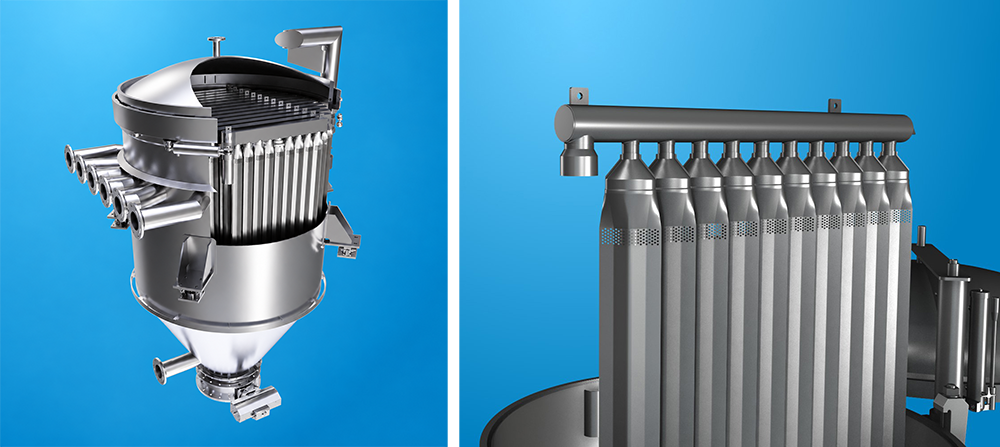
Pressure cake filtration technologies can provide an effective solution for demanding industrial applications. Companies such as Amafilter®, Filtration Group – a Parker Hannifin company – have developed the Cricketfilter® automated systems, incorporating robust filter elements designed to withstand demanding operating conditions while delivering efficient solid-liquid separation. Where filterability is uncertain, Amafilter® can conduct laboratory testing and on-site pilot trials to assess the application and help determine the optimum filtration technology before full-scale implementation.
The Cricketfilter® automated system is suited to applications requiring controlled cake formation and efficient solids removal. By applying pressure across the filter elements, liquid is separated from suspended solids, with the resulting filter cake subsequently discharged automatically. Depending on the process and suspension characteristics, this approach can support high filtration efficiency while helping manufacturers achieve consistent and repeatable results.
Automation is increasingly important in modern chemical production. Fine and specialty chemical processes can involve multiple stages and hazardous or sensitive materials. Reducing manual intervention can improve operational consistency while limiting operator exposure to process fluids and wet filter cakes. Automated filtration can support this through controlled filtration cycles, automatic cake discharge and reduced manual handling. Enclosed filtration can also help minimise contamination and exposure to chemical substances, particularly where product purity, containment and operator safety are critical.
Sustainability is another growing priority. Producers are under pressure to reduce waste, improve resource efficiency and make better use of raw materials and energy. Filtration can contribute by supporting recovery of valuable products, reducing material losses and improving downstream process efficiency. This is particularly relevant to oleochemical production, where manufacturers increasingly focus on renewable feedstocks and efficient utilisation of natural raw materials.
Flexibility is also important as manufacturers expand product portfolios and operate more varied production schedules. Filtration systems may need to accommodate different products, solids concentrations, particle sizes, viscosities and operating conditions. Equipment that can adapt to different applications can therefore provide greater operational flexibility.
For suppliers such as Amafilter®, the focus is on developing filtration solutions that address these evolving requirements. The Amafilter® Cricketfilter® automated system provides a robust, automated approach to pressure cake filtration, with potential applications across fine and specialty chemicals, oleochemicals and other demanding industrial processes.
As the industry continues to develop increasingly specialised products while seeking greater efficiency, reliability and sustainability, filtration will remain a critical part of chemical production. Selecting the right technology is about more than simply removing solids: it is about finding a separation solution that supports product quality, operational efficiency, safety and sustainability objectives.
For more information visit amafiltration.com.