





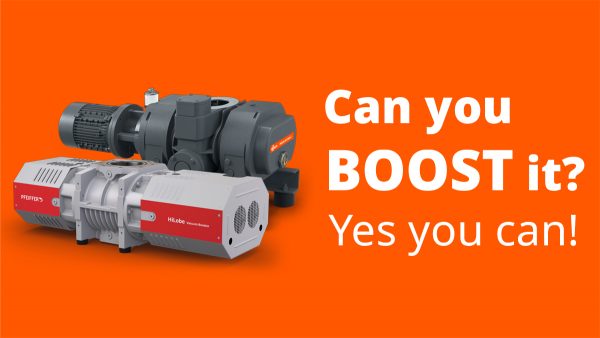
Vacuum boosters are essential in applications where high pumping speeds and low pressures are required, such as food packaging, coating, metallurgy, and leak detection. However, even small mistakes in their setup or operation can lead to costly downtime, equipment damage, or complete failure. In this article, we will explore the six most common mistakes made when operating a vacuum booster and how to overcome them.
Not allowing cooling time before reaching ultimate pressure
It is always recommended to allow a vacuum booster to cool down between running at maximum differential pressure and ultimate pressure. Maximum differential pressure occurs during the evacuation cycle and generates the most heat. As a result, the temperature rises suddenly, decreasing the clearance between the rotor and housing. At ultimate pressure, almost all gases have been removed. The rotary lobes spin at very high speeds, but there is minimal – or even zero – gas throughput. This means that heat cannot dissipate quickly through the gas and the surface of the casing. If repeated cycles are undertaken with insufficient cooling time, the lobes no longer have enough space to turn due to the decreased clearance, and the booster will seize. In extreme cases, this can lead to a total failure.
Improper temperature fluctuations
Sudden strong reductions in the ambient temperature during operation, especially at ultimate pressure, can be critical to a booster. The thermal shock causes the housing to contract while the lobes are still hot. Just like if insufficient cooling time is allowed, the necessary clearance between housing and lobes is reduced, with the result that the vacuum booster seizes. To prevent thermal shocks, the operator should avoid opening doors in the vicinity of the vacuum booster suddenly, especially in winter when temperature differences can be high. Additionally, boosters located outdoors must be protected from the rain by a roof or canopy.
Extreme care must also be taken in the event of fire. If fire-extinguishing water is directed at the vacuum booster, the housing could crack. This is particularly a concern for boosters with gray cast iron housings. Nodular cast iron, with its higher material strength, is better suited to withstand such thermal fluctuations.
Allowing sudden fluid inrush
Fluid inrush is a risk in processes that involve condensable vapors, wet gases, liquid transfer, or thermal cycling. This includes applications such as vacuum distillation and vapor recovery. Small amounts of fluid can be evaporated quickly and easily due to vacuum being generated by the backing pump and vacuum booster – under vacuum, the reduced pressure lowers the fluid’s boiling point, allowing it to vaporize rapidly even at lower temperatures. However, if large amounts of fluid suddenly flow from the process into the vacuum pumps, problems can arise. This sudden fluid inrush can have the same effect as air temperature reductions, causing abrupt cooling and ultimately destroying the booster. The additional quantity of fluid cannot be evaporated quickly enough, and the pressure at the forevacuum side may rise to excessive levels, which can cause issues like overheating, stalling, or mechanical damage. To prevent this kind of situation from arising, a recipient such as a liquid separator should be placed between the process chamber and the vacuum booster so that the liquid is removed before it reaches the booster.
Not observing the correct ratio between booster and backing pump
In applications requiring cycle times of just a few seconds, such as rapid-cycling load locks, the operator must ensure that the staging ratio – the ratio of the pumping speed of the vacuum booster compared to that of the backing pump – is small, such as 2:1. The staging ratio defines the system pump-down time, energy usage, overall equipment cost, equipment footprint, and the heat that is generated during operation. Higher staging ratios are possible but at the expense of cycle time, and therefore the staging ratio is chosen considering the application requirements.
For a small load lock chamber like those used in semiconductor wafer transfer, for example, this could mean a pumping speed of 500 m3/h for the booster and 250 m3/h for the backing pump. The reason for this is that from atmosphere to around 100 hPa (mbar), the gas has the highest density and contains the largest number of molecules to remove, so even a low pumping speed is sufficient. This region is primarily evacuated using the backing pump. However, as the pressure drops, so does the number of molecules per liter, so a much higher pumping speed is needed in the form of a booster to remove molecules at a useful rate. Backing pumps are built to handle dense gas and large pressure differences, but not high volumetric flow. Boosters, on the other hand, are optimized for moving large volumes of very thin gas, which is why their pumping speed is higher.
Below 100 hPa (mbar), vacuum boosters greatly increase the volumetric flow of the system, reaching maximum throughput below 10 hPa (mbar). For this reason, the backing pump must be appropriately sized so that it can reach 100 hPa (mbar) pressure efficiently. Incorrect sizing of the backing pump can have several negative consequences: Firstly, a small backing pump will increase the cycle time, which will negatively affect the productivity of the application and potentially cause defects or lower product quality. Secondly, energy consumption will also increase as the vacuum pumps work harder to achieve the desired vacuum levels. And finally, the extra strain accelerates wear on both vacuum booster and the backing pump, causing an increase in maintenance needs and the associated costs.
Allowing dust and debris to accumulate
Certain processes, such as metallurgy and crystal pulling, generate significant amounts of particles and dust. It is therefore recommended to install dust filters on the inlet side to protect both the vacuum booster and the downstream vacuum pump. This prevents the debris from entering the vacuum pumps and causing damage in the compression chamber, which could otherwise lead to reduced efficiency, increased maintenance needs, and process interruptions.
In addition, inlet mesh screens should be installed at the inlet of the vacuum booster to stop larger particles from entering. This also protects against welding beads that may be released from the welded joints in the pipework. It is recommended to use inlet mesh screens supplied by the vacuum pump manufacturer to ensure that the free cross-section matches the nominal inlet diameter of the vacuum pump. This ensures that the pumping speed is not compromised due to conductance losses. If the mesh screen has a smaller opening than the vacuum pump’s nominal inlet diameter size, it restricts the gas flow. As a result, the effective pumping speed drops. Using mesh screens designed by the pump manufacturer ensures the opening is large enough so that the performance of the vacuum pump is not reduced.
Not ensuring leak tightness when handling critical gases
When pumping costly, pure gases such as helium-3 or helium-4, any exchange with the ambient air must be avoided. These gases are extremely valuable and are often used in applications requiring very high purity levels. Even small amounts of contamination caused by air ingress can significantly affect the quality and effectiveness of the gas in these applications.
A high level of tightness is therefore essential for the vacuum pump, with leak rates below 10-5 (mbar) l/s. Shaft sealing rings can sometimes be a problem in this regard: they may develop leaks as they wear. For this reason, vacuum pumps with permanent magnet couplings are recommended instead of conventional shaft feedthroughs.
It is also possible to use a vacuum booster with a canned motor. A canned motor encloses the rotor in a hermetically sealed can, eliminating the need for external shaft seals and therefore removing the potential leak points. However, because the canned motor is developed for one particular vacuum pump, it must be serviced exclusively by the vacuum pump manufacturer. Magnetic couplings, in contrast, allow the use of standard, more cost-efficient motors.
Conclusion
Proper maintenance and operation are key to maximizing the efficiency and lifetime of a vacuum booster. By following best practices such as allowing cooling time before reaching ultimate pressure, avoiding sudden temperature fluctuations, maintaining the correct ratio between the vacuum booster and the backing pump, preventing fluid inrush, installing dust filters, and ensuring leak tightness when handling critical gases, operators can significantly reduce the risk of equipment failure and operational downtime.
Understanding these common mistakes and implementing the recommended practices will not only enhance the performance of the vacuum booster but also contribute to safer and more economical industrial processes.
About the Busch Group
The Busch Group is one of the world’s largest manufacturers of vacuum pumps, vacuum systems, blowers, compressors, chambers and gas abatement systems. Under its umbrella, the group houses two well-known brands: Busch Vacuum Solutions and Pfeiffer Vacuum+Fab Solutions.
The extensive product and service offer includes solutions for vacuum, overpressure and abatement applications in all industries, such as food, semiconductors, analytics, chemicals and plastics. This also includes the design and construction of tailor-made vacuum systems and a worldwide service network.
The Busch Group is a family business that is managed by the Busch family. More than 8,000 employees in 47 countries worldwide work for the group. Busch is headquartered in Maulburg, Baden-Württemberg, in the tri-country region of Germany, France and Switzerland.
The Busch Group manufactures in its 20 own production plants in China, the Czech Republic, France, Germany, India, Romania, South Korea, Switzerland, the United Kingdom, the USA and Vietnam.
The Busch Group has an annual consolidated revenue of 2 billion Euro.
Media Contact
Amy Jugessur
Operational Marketing Manager
Busch (UK) Ltd
Hortonwood 30, Telford, Shropshire
TF1 7YB, United Kingdom
+44 1952 678 722
amy.jugessur@buschgroup.com