




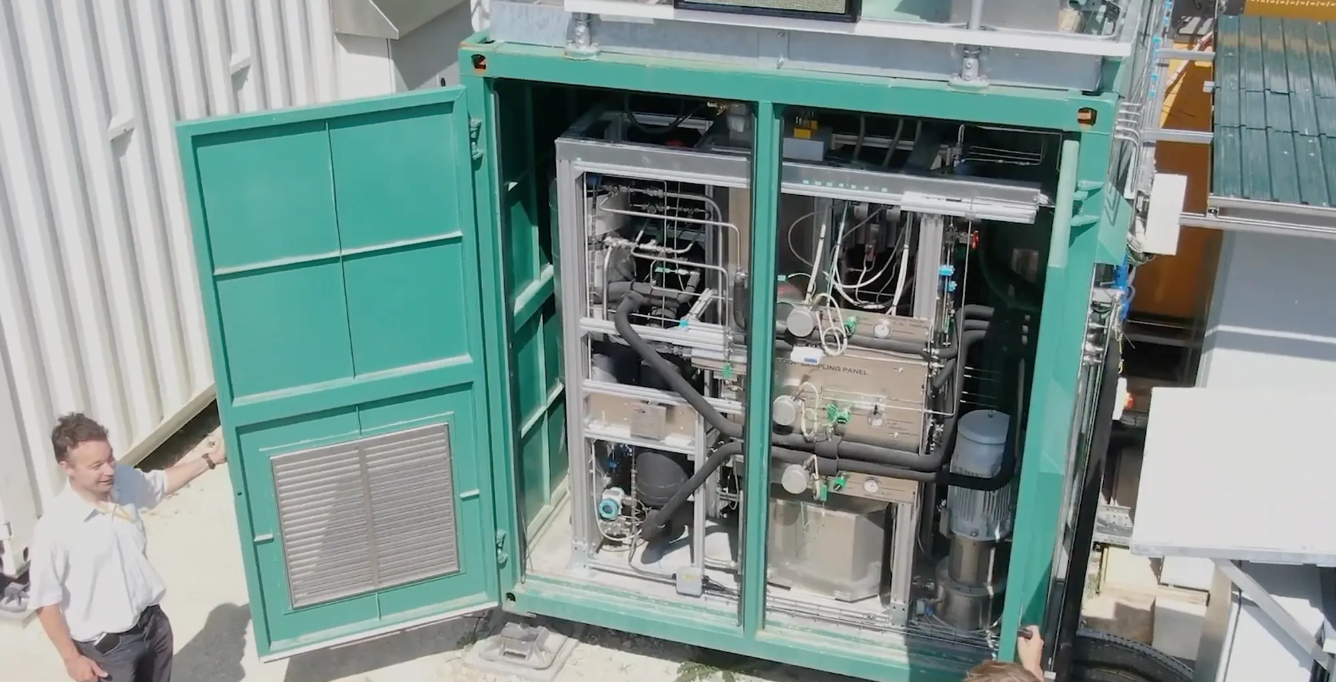
A prototype facility designed to manufacture ammonia using renewable electricity is now operational.
ngineers at the Science and Technology Facilities Council’s (STFC) Energy Research Unit powered up the facility, marking a significant advancement for the UK’s green energy strategy.
The process offers a way to store previously unused generated energy in the form of hydrogen molecules within the ammonia. The hydrogen in the ammonia can later be extracted and used to generate electricity at a more useful and convenient time.
The ASPIRE (Ammonia Synthesis Platform using Intermittent Renewable Energy) plant is an innovative demonstration of technology that is capable of the flexible generation of green ammonia and the storage of hydrogen for future extraction.
It was funded as part of the Department’s £1 billion Net Zero Innovation Portfolio which provides funding for low-carbon technologies and systems and aims to decrease the costs of decarbonisation helping enable the UK to end its contribution to climate change.
This technology facilitates green ammonia synthesis from otherwise unused wind energy with a flexible approach that allows the generation of ammonia in accordance with the fluctuating availability and cost of the renewable energy supply.
Data collected from the operational plant will be crucial for future scaling efforts, ultimately enabling green ammonia to compete commercially with traditional fossil-fuel-based production.
This development comes at a critical time as the UK invests £1.1 billion for offshore wind – ‘the backbone of the UK’s clean energy mission’ – to create a zero-carbon electricity system by 2030, part of the UK’s broader commitment to reduce emissions by 81% by 2035.
In 2024, about one-tenth of all wind generated power in Great Britain was produced but not used.
ASPIRE addresses energy efficiency challenges by utilising otherwise unused wind energy and also has the potential to:
• Decarbonise shipping and fertiliser manufacturing
• Provide grid resilience by converting stored ammonia back to electricity during peak demand or when energy supply is low
• Supply low-carbon hydrogen for fuel via ammonia cracking
Green ammonia presents significant climate change mitigation through these applications, potentially delivering 10-15% of global CO2 emissions reductions.
ASPIRE also brings significant advantages over traditional ammonia production methods:
• Reduces 90% of the carbon emissions relative to conventional ‘grey’ ammonia production
• Reduces 70% of the carbon emissions of ‘blue’ ammonia production
• Scalable technology that can operate directly from renewable sources
• Ideal for integration with the UK’s expanding renewable energy infrastructure
• Utilises low-cost electricity during periods of excess renewable generation
• Avoids carbon emissions penalties
• Not subject to volatile gas prices that affect conventional ammonia production
The UK’s recent introduction of the Carbon Border Adjustment Mechanism (CBAM) and Hydrogen Allocation Round subsidies are expected to help overcome one of the key barriers to green ammonia adoption – the current cost advantage of fossil fuel-based production.
Tristan Davenne, Principal Engineer at the STFC Energy Research Unit and ASPIRE project lead, explains: “This marks the culmination of years of intensive research and engineering innovation. What makes ASPIRE notable is its ability to produce ammonia at variable rates and its readiness for scalability in industry. ASPIRE is not just a technical achievement – it is a practical solution that can transform unused wind energy from a challenge into a valuable resource. The data we gather from this operational plant will be invaluable as we work towards scaling this technology to make green ammonia compete with fossil-fuel-based production.”
How the ASPIRE plant operates
1. The system utilises renewable electricity, primarily focusing on periods when wind turbines generate surplus power that exceeds grid demand.
2. This renewable electricity powers an electrolysis unit that splits water (H2O) into hydrogen (H2) and oxygen (O2). The hydrogen is captured for the next stage while the oxygen is either released or collected.
3. Simultaneously, an air separation unit extracts Nitrogen (N2) from the atmosphere through a pressure swing adsorption process.
4. The captured hydrogen and nitrogen are fed into a modified Haber-Bosch reactor containing proprietary catalysts. These catalysts enable the reaction of nitrogen and hydrogen to form ammonia (NH3) at lower temperatures and pressures than conventional ammonia production requires. The thermal design of the reactor maintains optimum conditions irrespective of the available power and ammonia demand.
5. The resulting green ammonia is liquefied and stored in specially designed tanks, where it can remain indefinitely without degradation. Liquid ammonia has significantly higher energy density than compressed hydrogen and even liquid hydrogen.
The different colours of ammonia production
• Green ammonia is produced using renewable energy sources (such as wind or solar power) to power the electrolysis of water, creating hydrogen that is then combined with nitrogen from the air, resulting in zero-carbon ammonia production.
• Blue ammonia is made using natural gas, with the carbon emissions from the process captured and stored underground through carbon capture and storage (CCS) technology, significantly reducing its carbon footprint compared to conventional methods.
• Grey ammonia is manufactured through the traditional Haber-Bosch process using natural gas or coal as feedstock, with carbon emissions released directly into the atmosphere, making it the most carbon-intensive production method.