





We analysed 70 case studies from a range of industries, including food, electronics, chemicals, aerospace, metalworking, and automotive manufacturing. Our research sheds light on:
- Reasons small manufacturers implement an ERP
- Average implementation timelines
- Benefits of ERP software for small manufacturers
ERP implementation statistics at a glance
Here are some of the key takeaways from our research:
- 74% of small manufacturers lack operational visibility before switching to ERP.
- 64% rely on spreadsheets before adopting ERP software.
- 82% report improved inventory accuracy after implementation.
- 81% report reduced administrative work.
- The median ERP implementation time for small manufacturers is 2 months.
How we conducted the research
- Sample size: 70 MRPeasy customer case studies.
- Company type: Small manufacturers.
- Company size: Median 15 employees; range 1–200 employees (Employee count known for 55 companies)
Why small manufacturers switch to ERP software
For every small manufacturer, the reason for switching to ERP software depends on different factors.
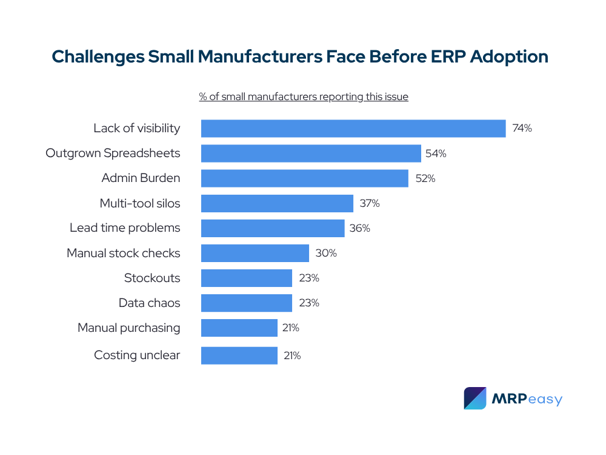
The most common issue, reported by 74% of small manufacturers, was a lack of visibility into operations. 54% of small manufacturers said they switched to ERP because they outgrew spreadsheets. In addition, 52% said that the administrative burden created by their systems led to ERP adoptions, 37% said multiple disconnected tools proved inefficient, and 35% pointed to lead time issues.
“Sage didn’t have the capacity for production scheduling – so to that end, we used Microsoft Excel,” says Chris Landen, Managing Director at Bristol-based Exacta Technologies. “The manual data inputs made the system prone to mistakes and we knew it was not scalable; finally, we felt we had reached a limit.”
Benefits of ERP implementation for small manufacturers
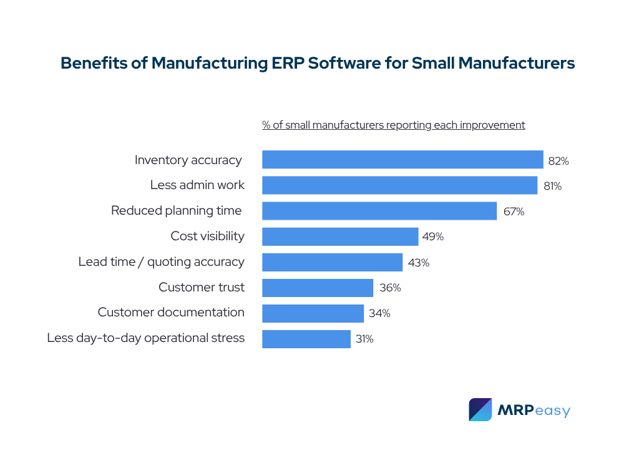
Here are the most common benefits of implementing ERP software for small manufacturers:
- 82% of small manufacturers said that ERP software improved inventory accuracy
- 67% said that production planning time was reduced
- 49% noted an improvement in cost visibility
- 43% reported improvements in lead time accuracy and quoting
In many cases, implementing an ERP system also had a noticeable impact on the customer experience. 36% of small manufacturers reported that customer trust increased after implementing an ERP, and 34% noted improvements in customer documentation.
Another benefit of ERP implementation is the reduction in administrative work and day-to-day stress.
- 81% of small manufacturers in our study said ERP software has significantly reduced administrative work
- 31% said ERP software has reduced day-to-day operational stress
“Even though it’s still relatively new, the benefits are already incredible. Time savings are enormous; the system makes everything so quick,” says Tony Green, Founder of Bradenham Preformed Wood Components.How long ERP implementation takes for small manufacturers
ERP software is often associated with long implementation times, with large-scale systems often taking years to implement. Software like MRPeasy can significantly reduce implementation time for small manufacturers. Here’s what our research found:
- ERP implementation time ranged from 2 days to 12 months.
- The median implementation time was 2 months.
Implementation also largely depends on company size. Larger companies typically need more time for process configuration, data migration, and team alignment, and also have more employees to train, and more products, parts, and BOMS to manage. Here are the median ERP implementation times, based on company size:
- 10 or fewer employees: median implementation time of 1 month
- 11–25 employees: 2 months
- 26–50 employees: 3 months
- 51+ employees: 6 months
For more information, please visit mrpeasy.co.uk