





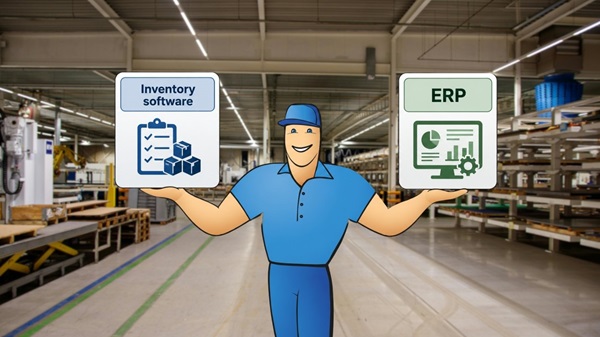
Many growing manufacturers turn to inventory management software to cure their stock-related ailments. But simple inventory software might not be enough for serious manufacturers if it lacks manufacturing-centric features.
Why inventory cannot be separated from production
The biggest reason manufacturers outgrow inventory software is simple: inventory decisions depend on production decisions.
In a manufacturing business, stock levels do not tell the whole story. A component may be physically in the warehouse but already allocated to another job. A finished product may be in stock but reserved for a customer. A raw material may look available in the system, but production may have already consumed it on the shop floor. A purchase order may be open, but the supplier may not deliver in time for the planned production date.
This means that inventory tracking alone is not enough. Manufacturers need to understand availability in context.
That context comes from BOMs, sales orders, material planning, procurement, and production schedules. A bill of materials defines which materials and components are required to make a product. Material planning uses BOMs, demand, lead times, current stock levels, and open orders to calculate what needs to be purchased or produced. Production planning determines when materials are needed. Procurement ensures they arrive on time. Costing shows how material, labor, overhead, and landed costs affect profitability.
If these functions are disconnected from inventory management, the company may have stock data but still lack operational control.
This is where standalone inventory software can become frustrating. It may give warehouse staff better visibility, but production planners still have to work outside the system. Buyers still have to manually check requirements. Sales teams still need to ask someone whether an order can be delivered. Managers still do not have a reliable view of production readiness, cost, or capacity. In other words, the inventory system becomes another silo.
Why manufacturing ERP is usually the better choice
For manufacturers, a manufacturing ERP solution such as MRPeasy is usually the better choice because inventory is inseparable from the rest of the operation.
Standalone inventory software can help companies improve stock tracking, warehouse management, barcode scanning, reorder points, and inventory control. But manufacturing inventory is shaped by sales, quoting, BOMs, procurement, MRP, production planning, costing, warehousing, and order fulfillment.
If those processes are disconnected, inventory software eventually becomes another tool that teams have to work around. It may show stock levels, but it cannot provide the full context needed to make reliable manufacturing decisions.
Manufacturing ERP solves this by connecting inventory with the processes that create, move, consume, purchase, cost, and sell stock. It gives manufacturers one system for managing materials, production, purchasing, sales orders, warehouse operations, and financial visibility.
So, inventory software vs. ERP: which is better for manufacturers?
For basic stock tracking, inventory software can be enough for a while. But for manufacturers that want better planning, automation, operational efficiency, cost control, and real-time data across the business, manufacturing ERP is the stronger long-term solution.