





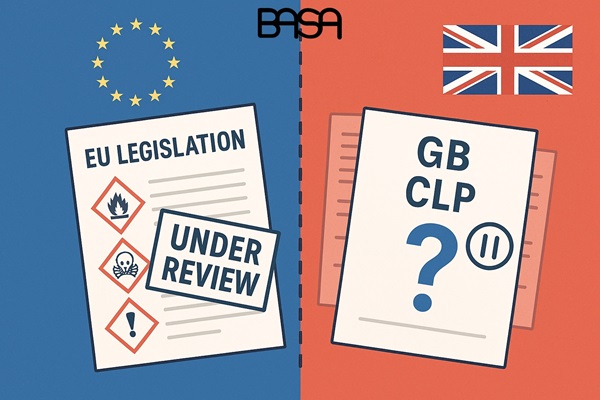
Before setting out our views on the specific measures under consideration, we want to register a significant overarching concern: the regulatory uncertainty created by the EU’s Chemicals Omnibus process.
Several of the measures in this consultation originate in or closely track EU CLP amendments, amendments that are currently under review as part of the EU’s broader effort to simplify and rationalise its chemicals legislation. There is a real risk that GB could adopt requirements which the EU itself subsequently amends, delays, or withdraws. We consider it premature to implement measures that remain in flux. We therefore urge HSE to monitor the Chemicals Omnibus process closely and to stage implementation in a manner that allows for the pausing or deferral of specific measures where the EU position remains unsettled.
We are also asking HSE to take seriously the cost burden that any relabelling requirements would impose on our members. Relabelling is not a trivial exercise. For businesses with large and diverse product portfolios, it involves artwork redesign, print plate changes, supplier negotiations, stock write-offs, and complex supply chain transitions. These costs fall disproportionately on smaller manufacturers and brand owners. Our members have already absorbed considerable relabelling costs as a direct consequence of post-Brexit regulatory changes, and further mandated rounds, particularly if driven by EU measures that may themselves be revised, would represent a poorly-timed financial burden on businesses still recovering from that disruption.
We are calling on HSE to carry out a robust and realistic impact assessment of relabelling costs before proceeding, to provide adequate lead-in times that allow businesses to manage label transitions through natural stock rotation, and to explore whether changes can be consolidated to minimise separate relabelling exercises.
On the EU’s six new hazard classes specifically, our position is clear: Great Britain should implement these classifications only if and when they are adopted through the United Nations Globally Harmonised System process, not by unilaterally tracking EU regulatory divergence. This approach provides the most coherent, internationally aligned basis for classification in GB, ensures consistency with global supply chains, and avoids the complexity of adopting EU-specific classes not yet reflected in GHS. We are urging HSE to hold this line.
BASA represents the £1.7 billion UK and Irish adhesives and sealants sector, promoting innovation, compliance, and sustainability while supporting business growth and industry standards. Visit http://www.basa.uk.com