





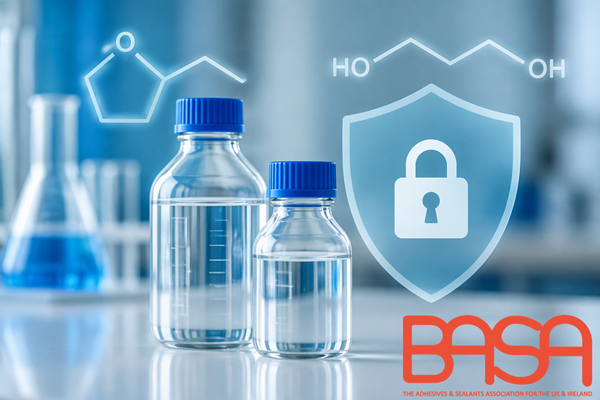
BASA (the Adhesives & Sealants Association for the UK & Ireland) has responded to the Home Office consultation on new controls for gamma-butyrolactone (GBL) and 1,4-butanediol (1,4-BD), supporting the government’s aim of preventing their misuse.
GBL and 1,4-BD are valuable industrial chemicals. In our sector, 1,4-BD is used to build polyurethane adhesives and sealants, and GBL is used as a solvent in some formulations and removers. Both substances are also converted into GHB in the body. They have been misused in drug-facilitated sexual assault, robbery and murder, and high-purity product has been sold online under the guise of “cleaning products”.
At present, anyone can trade GBL and 1,4-BD without a licence as long as it is not meant for human consumption. The government proposes to replace this broad exemption with a narrower one: products would stay licence-free if they contain no more than a set percentage of GBL or 1,4-BD and are mixed with other organic substances. High-purity material would need a Home Office controlled drugs licence.
BASA supports Option 1, which sets that limit at 70%. We believe it strikes the right balance. It closes the loophole that lets near-pure product be sold for misuse, while finished adhesives and sealants, which typically contain far less, stay outside licensing. We also welcomed the government’s decision not to remove the exemption altogether, which would have placed controls on everyday products with no benefit to public safety.
In our response, we asked the government to:
- make clear that “organic solvent” includes the polyols, resins and other organic ingredients found in reactive formulations
- confirm that unreacted traces of 1,4-BD in cured products are not caught
- offer a quick, proportionate licensing route for companies that buy high-purity raw material
- allow a transition period of at least 12 to 18 months, with guidance ready from the start
“Nobody in our industry wants these chemicals ending up in the wrong hands,” said Lorna Williams, BASA CEO. “These proposals protect the public while letting legitimate manufacturers carry on making the products that construction, packaging and manufacturing rely on. We’ll keep working with the Home Office as the detail is developed.”
The government expects to publish its response by 8 February 2027.
BASA represents the £1.7 billion UK and Irish adhesives and sealants sector, promoting innovation, compliance, and sustainability while supporting business growth and industry standards.
Visit http://www.basa.uk.com