





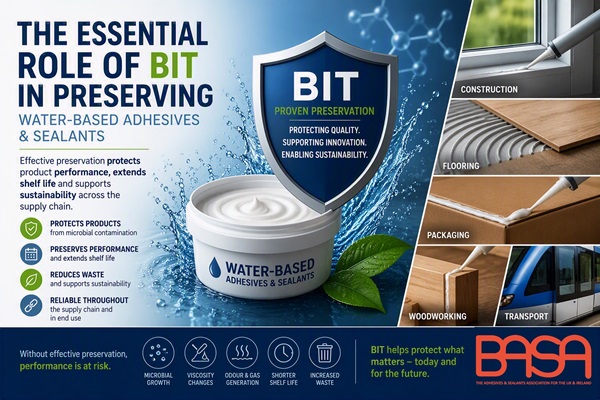
Water-based adhesives and sealants are an important part of the industry’s continuing move away from higher-solvent technologies. They support lower volatile organic compound emissions and safer product use across construction, flooring, packaging, woodworking, transport and many other applications. However, these benefits depend on one basic technical requirement: effective preservation.
BASA is concerned about the proposed identification of Benzisothiazolinone, commonly known as BIT, as a candidate for substitution under the EU Biocidal Products Regulation. BIT is one of the few remaining effective and technically viable preservatives available for many water-based adhesive and sealant formulations and associated raw materials.
Water-based products are not manufactured, transported, stored or used in sterile conditions. Polymer dispersions, emulsions, thickeners and filled formulations can support the growth of bacteria, yeasts and moulds. Good hygiene, raw-material controls and factory management are essential, but they do not remove the need for in-can preservation throughout the supply chain and during product use.
Without effective preservation, microbiological contamination can cause viscosity changes, gas generation, odour, discolouration, pH shifts, emulsion instability, loss of adhesion, shorter shelf lives, rejected batches and increased waste. For construction and industrial products, reformulation is not a simple ingredient swap. It can require microbiological challenge testing, compatibility and ageing studies, performance testing, revised safety data, customer approvals and, in some cases, re-certification.
Substitution must therefore be assessed by realistic use and formulation type, not by assuming that any approved preservative is a practical alternative. A suitable substitute must be effective against the relevant organisms, compatible with the product chemistry, stable over shelf life, commercially available and capable of being introduced without unacceptable impacts on performance, safety, supply continuity or sustainability.
BASA supports proportionate regulation of biocidal active substances. However, removing BIT without demonstrated suitable and sufficient alternatives could undermine water-based innovation, increase waste and create disproportionate burdens for downstream formulators, particularly SMEs. BASA urges regulators to retain BIT for essential PT6 uses where no workable alternative has been proven, supported by appropriate labelling, exposure controls and risk-management measures.
BASA represents the £1.7 billion UK and Irish adhesives and sealants sector, promoting innovation, compliance, and sustainability while supporting business growth and industry standards. Visit http://www.basa.uk.com