



For sectors that rely heavily on controlled atmospheres – such as chemical processing, advanced materials and metallurgy – closed-loop gas recovery presents a practical and commercially viable route to reducing emissions, improving supply chain resilience, and lowering operational costs. Insight by Dr. Rob Grant, FRSC, of cleantech company GR2L.
Industries in advanced materials and manufacturing sectors are increasingly focusing on reducing Scope 3 emissions. These indirect emissions, generated throughout the value chain, often constitute the largest and least controllable portion of a company’s carbon footprint.
Argon is essential for processes that require a stable, oxygen-free environment.
However, the conventional practice of a single pass-through application and subsequent venting incurs a substantial hidden carbon cost, primarily because of the energy-intensive processes involved in separation, liquefaction, storage, and transportation of the argon.
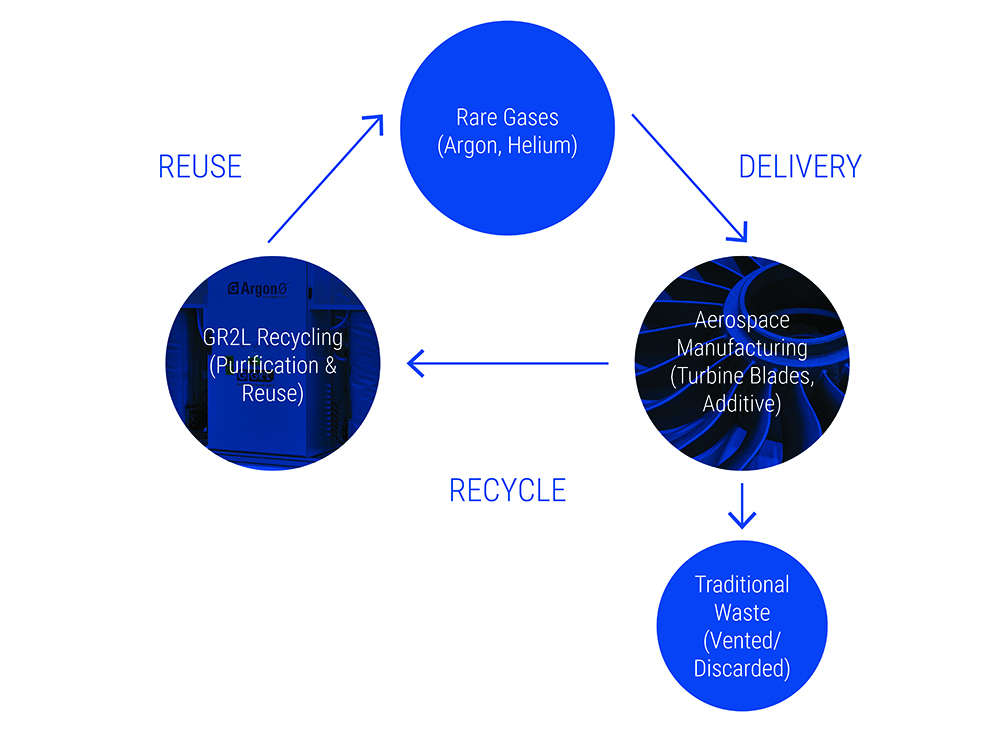
Closed-loop gas recovery is now emerging as a practical solution, transforming argon from a consumable into a reusable resource.
The overlooked issue of inert gases
Argon is produced through cryogenic air separation, a very energy-intensive multi-step process. Each step adds carbon emissions before the gas reaches a manufacturing facility.
For industries that use a lot of gas, this can be a major and largely hidden part of total emissions.
From linear consumption to circular use
Historically, industrial gases have been treated as disposable inputs. Once utilised, they are released into the atmosphere. Closed-loop recycling systems provide an alternative by capturing used gas, removing contaminants, and restoring it to a pure state suitable for reuse.
his approach enables facilities to substantially reduce their reliance on externally produced gas while simultaneously reducing carbon footprint.
Transitioning from linear consumption to circular use offers multiple benefits. It enhances supply security, reduces exposure to price volatility, and strengthens operational resilience, which is critical during periods of constrained industrial gas supply.
Metalysis, a global maker of high-value metal, alloy and high entropy alloy powders for advanced manufacturing, operates processes that need controlled inert atmospheres. To meet both sustainability goals and long-term operational efficiency, the company partnered with the GR2L1 team to implement the ArgonØ recycling system at its plant.
The system captures argon used in production, removes impurities, and returns the gas to a reusable state while meeting the strict purity standards needed for sensitive metallurgical work.
Measurable environmental impact
Installing this system will save Metalysis 350 tonnes of argon each year as 95% of the argon is recycled. The resulting reduction in energy used to process new argon and to transport it, will mean there are annual savings of 1000 tonnes of Scope 3 CO2. Every tonne of argon purchased brings with it at least another 2-4 tonnes of Scope 3 CO2 equivalent. The ArgonØ™ recycling system has an energy footprint of less than 10% of conventional gas recycling systems.
This data demonstrates that process-level interventions can yield immediate and quantifiable carbon savings without necessitating substantial modifications to existing production methods.
For Metalysis – which owns the disruptive Metalysis FFC process – originally developed as an energy and efficiency saving alternative to traditional titanium production – this partnership further demonstrates the company’s commitment to sustainability being built-in to the production process.
The Metalysis FFC process is already 50% more energy-saving than traditional titanium production processes generating powders for additive manufacturing, as it reduces oxides in the solid state rather than being a melting technology.
In addition to environmental benefits, this project reflects a broader approach to sustainability by integrating efficiency improvements directly into operational processes, rather than relying exclusively on offsets or external mitigation strategies.
Engineering sustainability into process design
A critical determinant of successful gas recycling initiatives is the capacity to maintain or enhance process reliability while minimising resource consumption. In high-temperature and materials-sensitive applications, any compromise in gas purity can lead to contamination, reduced yields, or product failures.
Modern recovery systems use advanced filtration, purification, and monitoring technologies to ensure that recycled gas meets high-quality standards. By designing systems tailored to the demands of advanced manufacturing environments, suppliers like GR2L enable sustainability improvements without compromising operations.
Recycling systems generally require only a fraction of the energy necessary to produce new argon via air separation. This significantly amplifies the overall carbon reduction, as each tonne of reused gas eliminates both production and transportation emissions.
Commercial and supply chain benefits
Although environmental considerations frequently motivate adoption, the economic advantages of gas recycling are equally significant. Industrial gas prices can fluctuate substantially due to energy costs, supply constraints, or geopolitical factors. Reducing dependence on external sources mitigates these risks for manufacturers.
Additional benefits include improved production consistency, enhanced ESG performance metrics, and increased resilience in energy-constrained environments. For large-scale facilities, these advantages can provide a substantial and marketable competitive edge.
Implications for the wider chemical and manufacturing sectors
The Metalysis project underscores a broader opportunity for industries reliant on inert gases. Many facilities have traditionally concentrated their decarbonisation efforts on visible energy consumption, often overlooking the embedded emissions associated with consumables.
Argon recycling demonstrates that significant Scope 3 emission reductions are achievable through targeted engineering solutions. As regulatory pressures intensify and customers increasingly demand supply chain transparency, such measures are likely to become essential rather than optional.
Additionally, because recycling systems can be easily retrofitted to existing setups, they provide a practical way for older facilities to enhance their sustainability performance without major plant redesign.
A pragmatic route to Scope 3 reduction
Addressing Scope 3 emissions remains one of the most challenging aspects of industrial decarbonisation. Unlike direct emissions, Scope 3 emissions fall outside immediate operational control and necessitate collaboration across the value chain.
Closed-loop argon recovery represents a practical, measurable, and economically viable solution. By decreasing demand for newly produced gas, manufacturers can substantially reduce their indirect emissions footprint and enhance operational resilience.
As industries pursue net-zero targets, innovations that integrate environmental impact with commercial value will become increasingly important.
The Metalysis experience indicates that reassessing established assumptions regarding consumables, such as inert gases, can uncover significant opportunities for sustainability and efficiency.
Reference
GR2L is a cleantech company focused on industrial gas recovery and recycling systems. Its technologies, including the ArgonØ™ system, are designed to capture, purify, and reuse process gases while maintaining the high purity standards required for advanced manufacturing applications. More information here.