





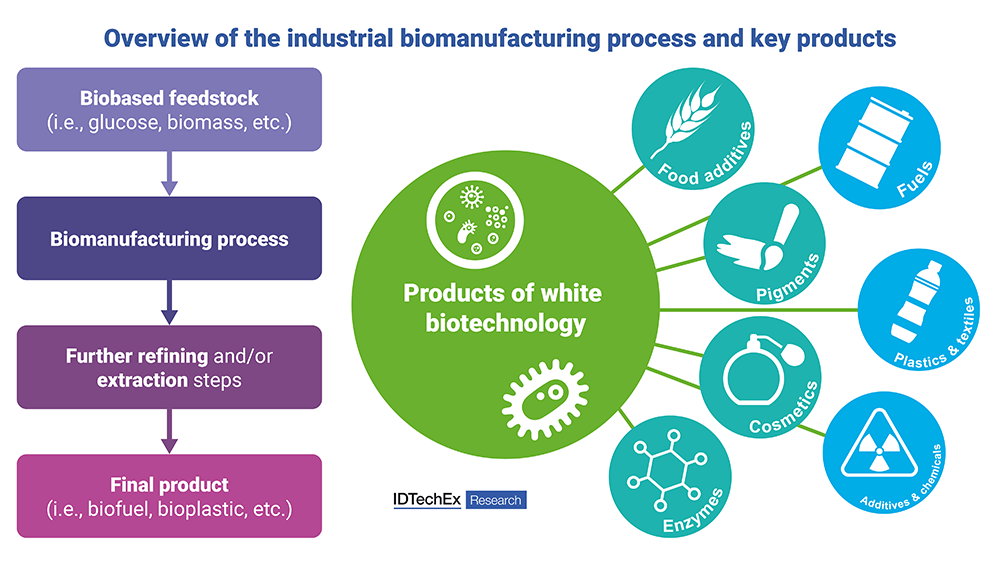
White biotechnology is a key step in a circular economy, enabling the transformation of waste to industrially useful chemicals via a sustainable process. Felix Wei, IDTechEx, delves into two of the key market drivers for industrial biomanufacturing: government policy and technology advancement.
Supply chain instability is a continuing challenge for the materials and chemicals industry.
White biotechnology, which enables the production of commodity and specialty chemicals from locally sourced bio-based feedstock, can be a promising pathway to localised economic resilience.
Today, ethanol is primarily produced via industrial biomanufacturing at a global annual volume of 25 – 30 billion gallons.
White biotechnology is constantly expanding its repertoire of output products, supercharged by disruptive innovations in synthetic biology and artificial intelligence.
Also known as industrial biotechnology, it uses enzymes and microorganisms at an industrial scale to produce and process biobased products in diverse sectors.
Our report, “White Biotechnology 2025-2035: Technologies, Forecasts, Markets, Players”, explores the key market drivers and technology advancements in the field and provides a comprehensive evaluation of chemicals currently produced using white biotechnology.
White biotechnology is gaining traction as a sustainable method to produce high-value specialty molecules as well as commodity chemicals, with two of its key market drivers being government policy and technology advancements.
Policymakers behind the push
Although white biotechnology is still very much the underdog compared to other mature chemical-based manufacturing, it promises a sustainable and resilient future industry.
With ongoing geopolitical instability, it is increasingly desirable to have decentralised regional supply chains for input raw materials. Specifically for white biotech, its feedstock – typically agricultural waste and gaseous residues – can be largely sourced locally. For example, locally manufactured bioethanol via microbial fermentation can be a source of alternative fuel that is not subject to the fluctuation of crude oil price.
In light of its potential as a disruptor to petroleum-reliant industries, world governments have passed favourable legislature surrounding the technology, as they seek to achieve carbon neutrality.
Regulations that aimed to reduce dependence on fossil fuels, plastic consumption, and carbon footprint in general have indirectly led to higher demand for bio-manufactured products. Such efforts are led by the EU, Japan, and China.
For instance, China aimed to eliminate single-use plastics by 2025. On the other hand, the US lags behind in such initiatives, and previous generous funding for domestic industrial biomanufacturing has been cut back, as governmental priorities shift under the current administration.
Technology improvements ramp up adoption
Industrial biomanufacturing is often hindered by the relatively lower efficiency of biological processes, but this might not be the case any longer.
With the maturation of synthetic biology tools such as gene editing and enzyme engineering, it is now possible to engineer microorganisms and biocatalysts that can accelerate biomanufacturing processes at a low cost.
One major player in the field informed IDTechEx that it is soon possible to sequence extremely complex human genome for only US$100, indicating that commercially useful chemicals will be bio-manufactured at significantly lower costs.
Artificial intelligence is another major propeller for white biotechnology. AI-driven protein design can reach unprecedented prediction accuracy and enable fabrication of enzymes with tailored function and performance, bypassing the limitation of naturally occurring enzymes.
Specifically, these tools can help produce biocatalysts that can withstand harsh industrial conditions in cell-free systems, opening up new possibilities in bio-based materials and chemical synthesis.
AI is also useful in downstream processing optimisation. Several companies, such as The Cultivated B and Arsenale Bioyards, use AI-assisted platforms to achieve real-time fermentation control to improve consistency in product yield and quality.
The outlook
White biotechnology occupies an irreplaceable and expanding niche in the materials and chemicals industry, despite being a relatively smaller segment.
We predict that the global production capacity will triple by 2035, driven by government incentives and technological advancements.
Much of the market share will continue to be taken by chemicals that can be uniquely produced via white biotechnology, with increasingly more petroleum-based productions making the transition and becoming economically competitive.
For more details on the white biotech market drivers, technology trends, company landscape, and market forecast, see the report.
Other market intelligence reports available here.