





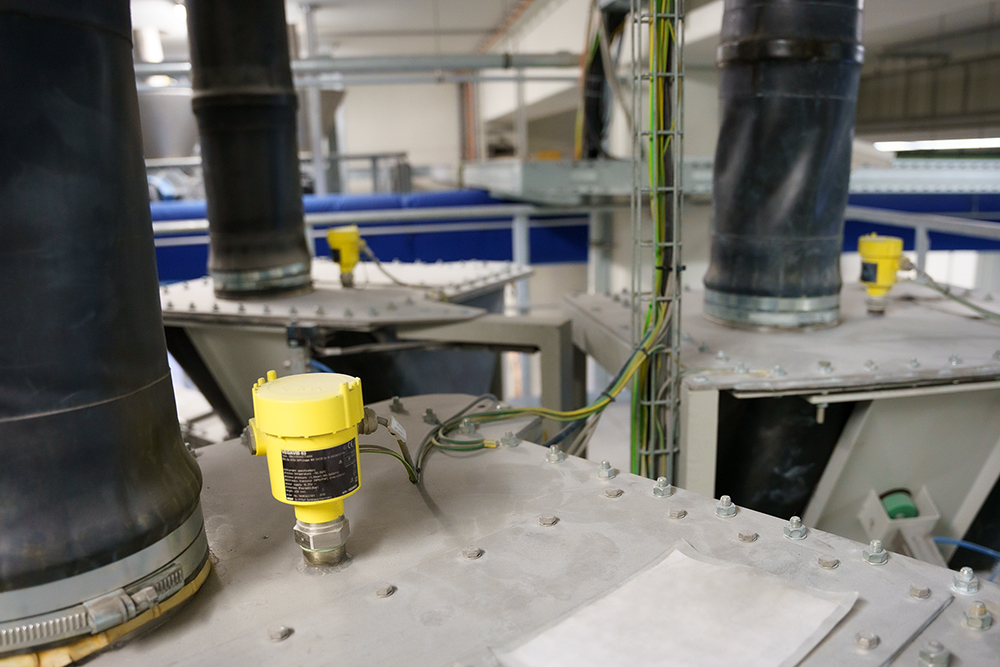
Optimisation of production processes is an ongoing task in plastics manufacturing, and this is also the case at RENOLIT. Traceability and reproducibility of processes are therefore key requirements for the manufacturer. With innovative level and pressure measurement technology from VEGA, important steps are now being taken at RENOLIT, especially towards climate neutrality.
Produced according to individual formulations that best meet customer requirements, RENOLIT’s plastic films as well as other products represent the highest level of functionality. This requires highly accurate dosing of the base materials – such as polymers, additives or colourants – under consistent process and ambient conditions. Since plastics production is very energy-intensive, measuring energy consumption is becoming increasingly important. VEGA sensors for level, flow and pressure play an important role here.
Universal level measurement technology – one level sensor for all container types
At RENOLIT, raw materials are stored in intermediate bulk containers (IBCs) for liquids with a capacity of 1,000 litres or in large outdoor silos for bulk solids with a capacity of up to 200 cubic metres. The levels have to be monitored with millimetre precision, without the need to open or modify the containers. Radar-based level measurement technology is the solution of choice here. As a universal radar sensor, the VEGAPULS 6X monitors a wide variety of measuring points and ensures that the correct quantities of each component are supplied at all times.
Procurement is made significantly easier by using universal radar technology
Since RENOLIT started using VEGAPULS 6X universally in its storage facilities, procurement has become much easier for the company. Although the configuration and the material in the silos vary depending on the specific product requirements, it is always important that the materials used are optimally stocked so that production runs efficiently and without interruption.
Energy savings thanks to flow measurement with pressure sensors
But optimal raw material storage isn’t the only source of significant savings potential. Along more than 300 metres of PVC film production line, energy consumption is continuously monitored, highlighting the scale of energy use involved. A key contribution to maintaining efficient operation comes from the temperature control units of the calender rollers, where three VEGADIF 85 differential pressure transmitters precisely monitor the flow of heating water. This ensures the process runs under optimal temperature conditions, supporting consistent product quality while aligning thermal energy consumption closely with actual demand.
Sensor replacement during the ongoing process
The differential pressure transmitters are each mounted with a gate valve, so that they can be serviced or replaced at any time without having to interrupt the ongoing process. The special dual-chamber electronics offer further potential for savings. With two VEGADIF 85 sensors, the static pressure and the differential pressure can be measured simultaneously. This is an advantage, because the static pressure is an important component for optimal process flow in the calender, which, thanks to the deployed pressure measurement technology, is now monitored without additional sensors.
Tracking down remaining energy guzzlers – with VEGA measurement technology
Just the new software modules alone, which have optimised the standby mode of all electrical devices, have allowed RENOLIT to reduce energy loss by 60 percent. To reduce consumption even further, the company has left no stone unturned when it comes to optimising remaining energy guzzlers like cooling and heating processes. RENOLIT will continue to rely on VEGA’s level and pressure instrumentation in the future – and thus on exact, reliable measured values that make the end products traceable and indicate where and when the plastics were produced and at what temperatures and speeds.