





By John Jaddou, Global Director of New Business Development, Orbia Fluor & Energy Materials.
The battery market is accelerating; annual battery installations are expected to nearly quadruple to 138 GWh by 2030 in Europe.
With EV adoption expected to continue growing significantly until at least 2030, batteries are becoming a cornerstone of the automotive sector.
Batteries are also an increasingly important source of backup power for digital infrastructure, including data centres and artificial intelligence, further driving demand for battery materials in the UK market.
Whilst momentum around renewable energy investment is positive, this power storage boom brings energy security worries of its own.
Currently, China are dominating the battery market, with Chinese producers accounting for 95% of large-scale storage batteries.
This concentration of manufacturing and supply, combined with accelerating demand, exposes the UK and EU to geopolitical uncertainty, supply disruptions, trade restrictions and price volatility, threatening long-term availability.
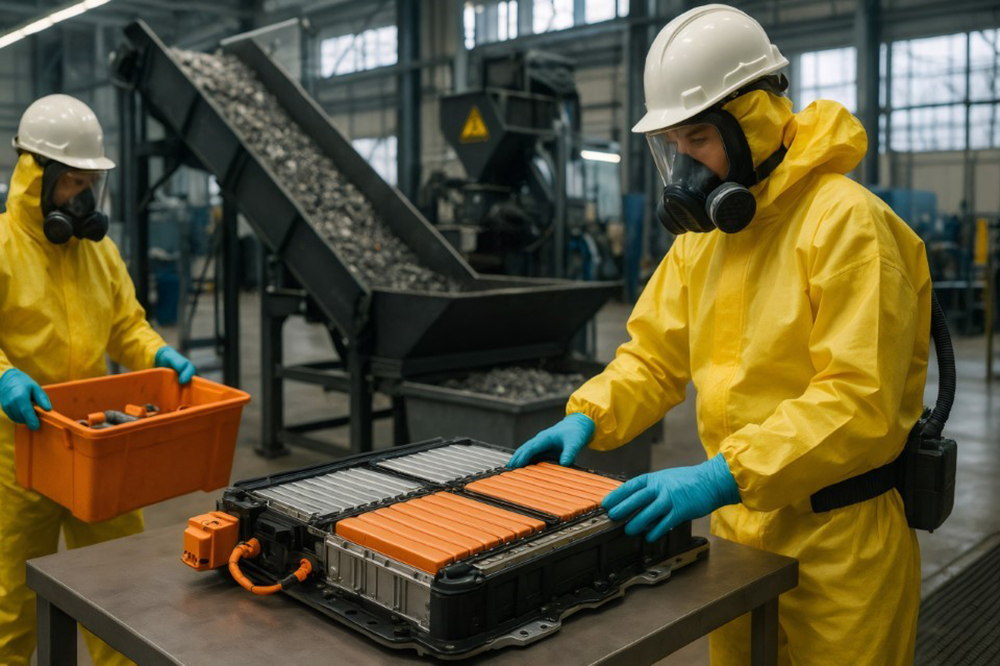
Right now, it’s imperative that the UK and EU power this net-zero economy; building a circular battery supply chain is a strategic necessity. Circularity through recycling and regional material processing should no longer be viewed as purely environmentally beneficial, rather as economical and industrial priorities.
This marks a new phase for the battery industry; one in which success will depend not only on the production of batteries, but also on how effectively manufacturers can recover, recycle and reuse the critical materials which are already in circulation.
Whilst lithium has traditionally been in the spotlight, graphite remains one of the most important components in lithium-ion batteries, accounting for around 30% of battery weight and serving as the primary material in the anode. By 2035, global demand for graphite is expected to exceed supply by roughly 2.5 million tons.
Currently, China dominates global graphite processing and supply. A Stanford University-led industry roundtable, held in Washington D.C. in June last year highlighted the urgency of addressing China’s control of this particular supply, citing domestic battery recycling to recover and reuse spent graphite as a key solution.
As battery demand grows, so does demand for graphite.
Material processing is a critical part of the UK securing battery independence. Expanding UK and EU processing capacity will strengthen supply chains and reduce the transport emissions involved in global shipping, as well as supporting domestic manufacturing growth.
Earlier this year, Orbia Fluor and Energy Materials secured a £1.4m grant from the UK Government to launch the country’s first graphite recycling project. Part of the UK’s DRIVE35 programme, the partnership aims to accelerate R&D in the automotive industry and increase scale for a low or zero-emission future.
Continued developments like this in the UK and EU will support investment in areas like energy storage, renewable power, and advanced manufacturing, creating skilled employment opportunities and supporting the growth of the economy.
With around 1.2 million electric vehicle batteries predicted to reach the end of their lifetime in 2030, and 14 million by 2040, recycling capabilities work to combat the significant volumes of waste generated by battery production and end-of-life batteries.
By recovering and reintroducing high-quality materials from production scrap and end-of-life batteries, not only is waste reduced, but so is dependence on one concentrated source of supply of virgin materials.
Material recovery plays a large part of building a strong circular economy, helping reduce exposure to supply disruptions, improve visibility over critical inputs, and support long-term cost stability as battery demand increases.
As industries look to define the next era of battery growth, the future of electrification depends on both innovation and resource stability.
With battery demand scaling, and EV numbers growing, circularity will become a vital cog in supporting long-term environmental and commercial security.
If the UK and EU want to ensure competitiveness in the market, they need to invest in battery recycling and material processing of essential battery materials now.